
HEARTWORM & FLEA PREVENTATIVES
Below are options for flea and heartworm preventatives. All drugs come with risks. Please consult your veterinarian for what product is best for your animal.
Heartworm prevention and/or flea sterilization
Interceptor: oral; prevents heartworms, hookworms, roundworms and whipworms. Learn more about Interceptor
Active ingredient: Milbemycin oxime
Program: given orally once a month; sterilizes female fleas that bite dogs; fleas are not killed so it may be necessary to use one of the listed topical flea controls in conjunction with this pill. Learn more about Program
Active ingredient: Lufenuron
Sentinel: oral; prevents heartworms, fleas, hookworms, roundworms and whipworms; contains Program & Interceptor. Learn more about Sentinel
Active ingredients: Milbemycin oxime + Lufenuron
Heartgard and Tri-Heart Plus
: oral; prevents heartworms, roundworms, and hookworms. Learn more about Heartgard and Tri-Heart
Active ingredients: Ivermectin + Pyrantel pamoate (Heartgard Plus)
Heartworm prevention + kill fleas in a topical oil
Revolution: topical; given once a month; prevents heartworms, fleas, ear mites, American dog ticks, and sarcoptic mange. Does not control hookworms, roundworms, or whipworms. You may need to use an additional dewormer. Learn more about Revolution
Active ingredient: Selamectin
Advantage Multi: topical; given once a month; kills fleas for one month; provides heartworm prevention for one month; can be used on puppies as young as seven weeks; also controls hookworms, roundworms, whipworms, and ear mites. Learn more about Advantage Multi
Active ingredients:
Imidacloprid + Moxidectin
Fleas and Ticks only- no heartworm prevention – topical oil
Frontline: topical; kills fleas (within 12 hours) and ticks (within 48 hours); protects against fleas for at least one month; protection may last longer in some dogs but is not labeled as three months for dogs; does not wash off with bathing, however, you do not want to bathe your dog for 48 hours prior to or following application; takes up to eighteen hours to fully spread across your dog’s body; can be used on puppies as young as eight weeks. Learn more about Frontline
Active ingredients (Frontline Plus): Fipronil + (S)-Methoprene
K9 Advantix II: topical (liquid placed on the back of your dog’s neck between his shoulder blades); repels and kills fleas, ticks, and mosquitoes for one month; also kills chewing lice and biting flies; does not wash off with bathing, however, you do not want to bathe your dog for 48 hours prior to or following application; for use on dogs only (toxic to cats). Learn more about K9 Advantix
Active ingredients (K9 Advantix II): Imidacloprid + Permethrin + Pyriproxyfen
• Vectra 3D: topical (liquid placed on the back of your dog’s neck between the shoulder blades); kills fleas, repels and kills ticks, mosquitoes, and chewing lice for one month; prevents flea eggs and larvae from developing; does not protect against heartworm, so should be used with a monthly heartworm preventive; for dogs only — toxic to cats; do not bathe your dog for 48 hours prior to or following application. Learn more about Vector 3D
Active ingredients / classes: Dinotefuran (neonicotinoid), Pyriproxyfen (insect growth regulator), Permethrin (synthetic pyrethroid)
Capstar: oral; kills fleas quickly after ingestion and last up to 24 hours. Learn more about Capstar
Active ingredient: Nitenpyram
Drugs to Avoid:
Please do not use Spinosad and Isoxazolines class of drugs for Fleas and Ticks. Using any of these drugs will VOID your 2-year Health Guarantee. Brands of drugs in this class of options include but are not limited to:
• Bravecto – Fluralaner
• Credelio – Lotilaner
• Comfortis – Spinosad
• NexGard – Afoxolaner
• Simparica – Sarolaner
• Simparica Trio – Sarolaner + Moxidectin + Pyrantel
• Trifexis – Spinosad + Milbemycin oxime
FDA’s Warning of hazards related to these flea products:
Fact Sheet for Pet Owners and Veterinarians about Potential Adverse Events Associated with Isoxazoline Flea and Tick Products
Spinosad and Isoxazolines are flea and tick medications that act on the nervous system. While many dogs tolerate them without issue, these drugs have been associated with serious neurological side effects, including tremors, seizures, loss of coordination, and death. Adverse reactions can occur in both healthy dogs and those with underlying neurological conditions.
Personal Note:
No, not yet
In my other breed, the amount of horrible and not-fixable neurological reactions are EXTREME AND COMMON to all brands of Oral Flea pills.
We should all keep in mind that any drug can have negative side effects. Please use caution. If you believe your dog is reacting negatively to any drug, contract your veterinarian or poison control immediately.
- Adverse Reactions to Spot-on Flea and Tick Products – Veterinary Partner – VIN Vet article going over minor side effects of flea and tick oils
- Veterinary overview of flea and tick medications: Dr. Aly Cohen is an extension veterinarian for the Cornell Richard P. Riney Canine Health Center and a clinical instructor for Cornell’s Maddie’s Shelter Medicine Program
- The Complete Guide to Flea and Tick Prevention and Treatment for Dogs at PetMD
- Facebook group: Are flea medications killing our dogs?
- Facebook group: Does Bravecto Kill Dogs?
- Facebook group: Bravecto Nexgard Comfortis Simparica Trifexis & others Do They Kill Dogs?
-
Flea and Tick Medicine Poisoning in Dogs by PetMD
- Search: EMA European Medicines Agency- adverse drug interactions
- Flea and Tick Medications: Adverse Event Findings Released by Project Jake, overview at HemoPet
- Project Jake full data sheet: Survey of canine use and safety of isoxazoline parasiticides plus FDA and EMA data
- The following two pictures are from the EMA’s data
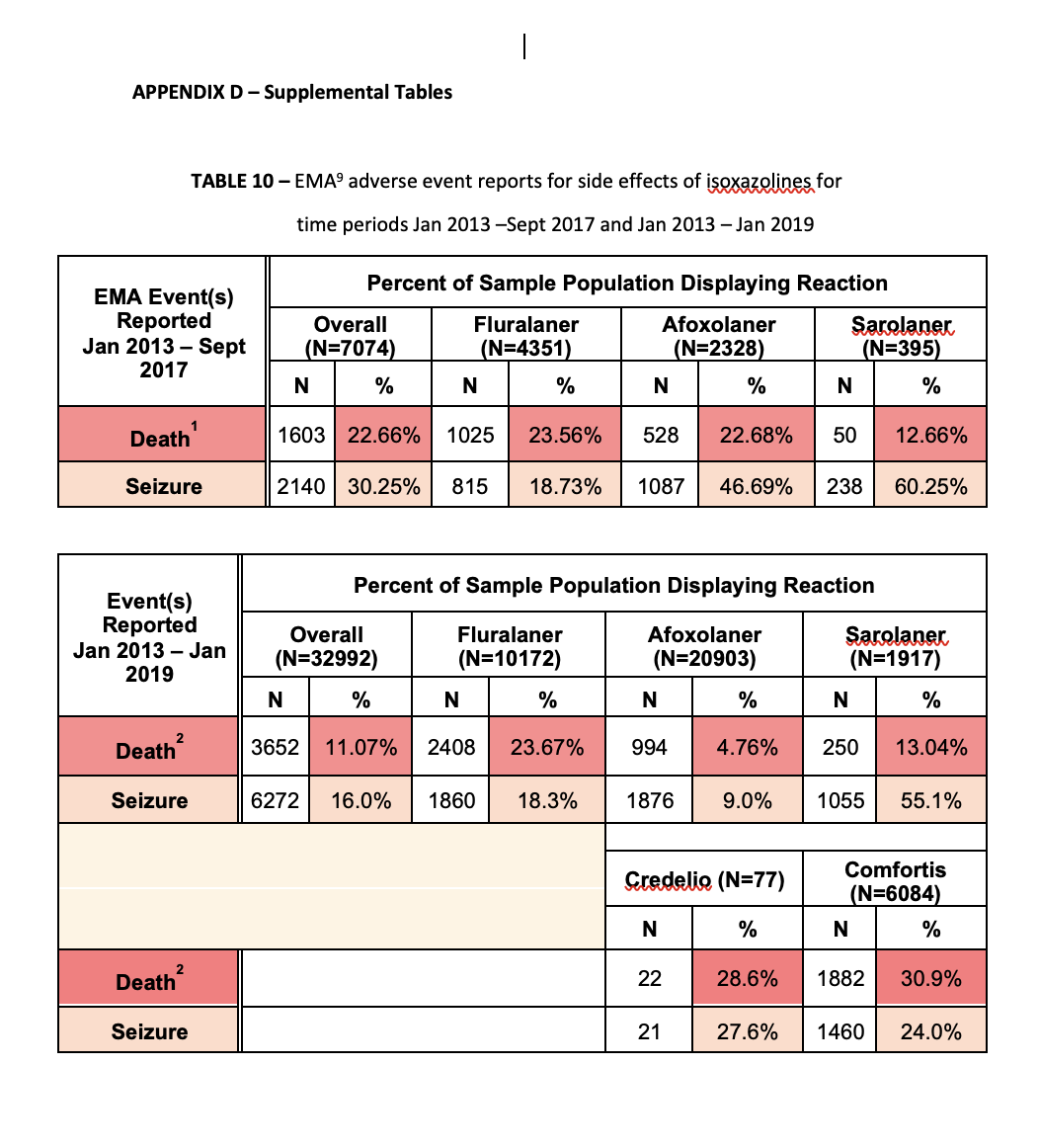
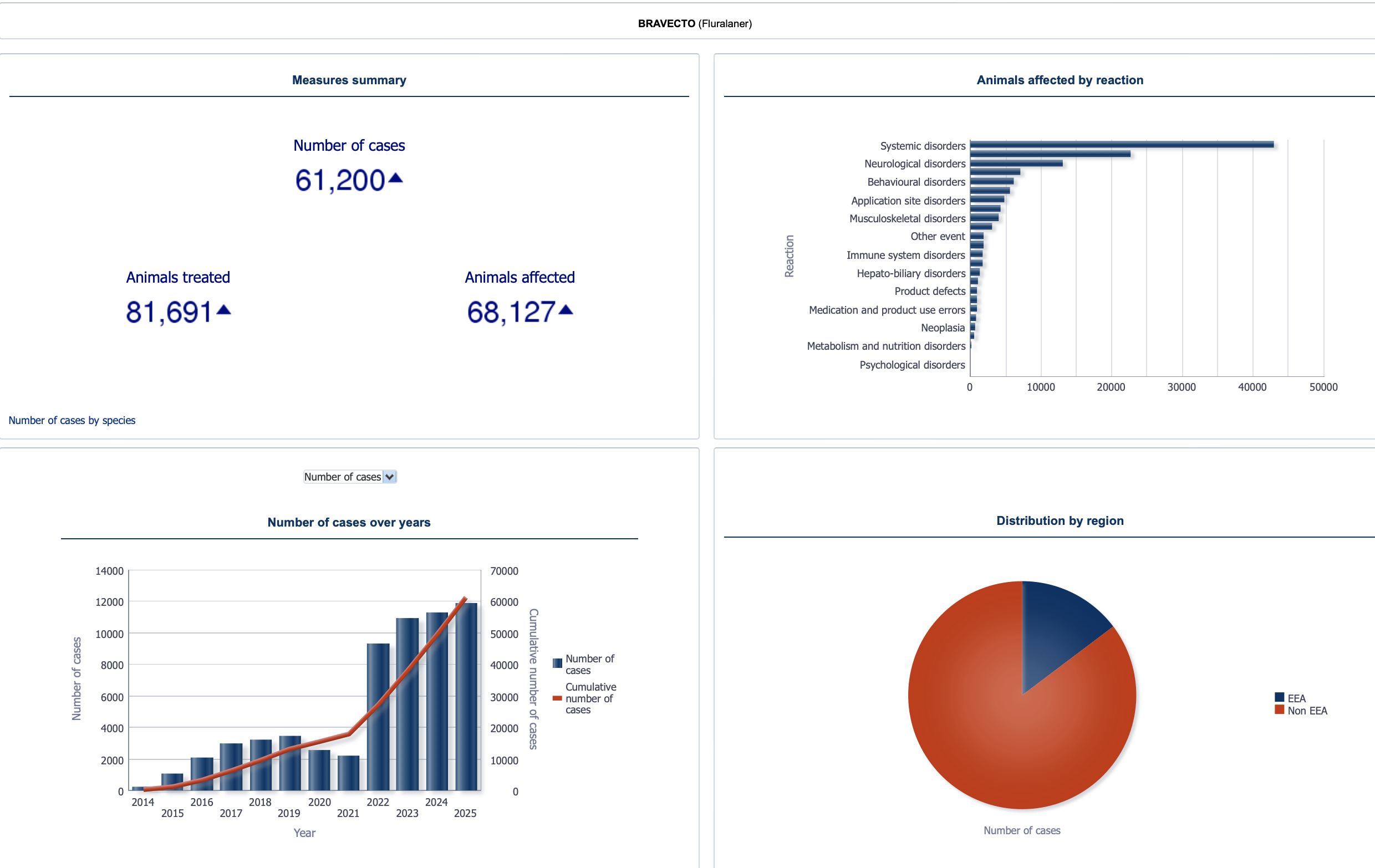
Field trial investigating the efficacy of a long-acting imidacloprid 10%/flumethrin 4.5% polymer matrix collar (Seresto®, Elanco) compared to monthly topical fipronil for the chemoprevention of canine tick-borne pathogens in Cambodia
The tropical brown dog tick, Rhipicephalus linnaei, transmits serious pathogens such as Babesia spp., Ehrlichia canis, Hepatozoon canis, and Anaplasma platys, posing a major risk to dogs in tropical regions. A 12-month community trial compared two topical tick-control products: the Seresto® collar (imidacloprid 10% + flumethrin 4.5%) and a monthly fipronil spot-on (Detick, Thailand). Both protected dogs effectively, but Seresto provided slightly better protection, with 3 TBP-positive dogs per 100 dog-years at risk compared to 11 per 100 dog-years for fipronil.
The most striking finding came from the baseline data: dogs previously treated with systemic isoxazoline acaricides were 2.7 times more likely to test positive for tick-borne pathogens than dogs that had received topical treatments. This highlights a critical point: in tropical environments with high tick pressure, systemic isoxazolines may be less effective at preventing disease transmission, whereas topical products like Seresto offer stronger protection against infection.
Systemically and cutaneously distributed ectoparasiticides: a review of the efficacy against ticks and fleas on dogs
Dogs can be treated for fleas and ticks using either topical or ingested medications, each with different strengths. Topical products, such as Advantix (permethrin combinations), Vectra 3D (dinotefuran + permethrin + pyriproxifen), and Frontline Tri-Act/Frontect (fipronil + permethrin), kill fleas quickly on contact. Advantix achieves 99.4% adulticidal efficacy within 24 hours and 99.2% larvicidal efficacy within three days, while Frontline Tri-Act kills over 99% of fleas within 6–24 hours, and some permethrin combinations can begin killing fleas within the first five minutes. Despite this rapid action, topical treatments may not cover the entire body evenly and a few parasites can survive.
Systemic treatments like fluralaner (Bravecto) work through the bloodstream when parasites bite. Fluralaner kills over 91% of fleas within 4 hours and ≥98% by 8–24 hours for up to 12 weeks, completely stopping flea reproduction and preventing environmental reinfestation. Field studies show nearly 100% flea reduction and flea-free households after treatment
A randomized, blinded, controlled and multi-centered field study comparing the efficacy and safety of Bravecto™ (fluralaner) against Frontline™ (fipronil) in flea- and tick-infested dogs
At weeks 2, 4, 8, and 12, Bravecto™ (fluralaner) flea-control efficacy in treated households was 99.2%, 99.8%, 99.8%, and 99.9% respectively, while Frontline™ (fipronil) efficacy was 94.1%, 93.0%, 96.0%, and 97.3%, respectively. Bravecto™ (fluralaner) tick-control efficacy on treated dogs at weeks 2, 4, 8, and 12 was 99.9%, 99.9%, 99.7%, and 100%, respectively, and Frontline™ (fipronil) tick efficacy was 97.6%, 93.8%, 100%, and 100%, respectively. Of dogs showing clinical flea allergy dermatitis (FAD) signs at the study start, 85.7% in the Bravecto™ (fluralaner)-treated group and 55.6% in the Frontline™ (fipronil)-treated group were evaluated at each time point as showing no clinical signs of FAD until study completion.
Isoxazolines are effective against ticks, but they can also induce significant hepatic damage in non-target hosts. Learn more
A study conducted by a Brazilian scientific team has been released recently suggesting: “…that while isoxazolines are effective against ticks, they can also induce significant hepatic damage in non-target hosts, compromising a vital organ essential for detoxification and systemic regulation… In rabbits, the exposure to the chemicals caused varying degrees of hepatotoxicity, characterized by extensive steatosis and alterations in the synthesis/secretion of proteins and polysaccharides by hepatocytes. Fluralaner (Bravecto®) resulted in a more severe hepatic steatosis than afoxolaner (Nexgard®). In conclusion, although effective in combating ticks, isoxazolines cause severe liver damage in host organisms” (read that as your dog is the host)
Canine Flea Control: too much choice?
Learn More
An overview of the flea medication options for veterinarians to consider. Many studies are referenced for each class of drugs. Studies show efficacy. 2019
By Sue Paterson, Veterinary Dermatologist
Over the past few decades, many insecticides have been approved for flea control, either alone or in combination. Older active ingredients such as fipronil, imidacloprid, lufenuron, methoprene, permethrin, and pyriproxyfen, most of which were introduced before 1997, are still widely used. Despite common claims, true flea resistance to these products is rare. Official resistance records show that cat fleas (C. felis) have mainly developed resistance to older chemical classes like organochlorines, carbamates, organophosphates, and pyrethroids, with only limited resistance reported for fipronil and imidacloprid in laboratory flea colonies. Many of these older products remain effective due to improved formulations, combination products, and generic versions. While most flea treatments require a veterinary prescription, some single-ingredient products are available without one. Even though these older treatments work well, new flea drugs continue to be developed to improve convenience, safety, and cost for pet owners.
Dogs transfer flea drugs into the environment: risk to humans
This study investigated how flea and tick products used on dogs can spread into the environment. Active ingredients from common brands: afoxolaner (NexGard®) oral, fluralaner (Bravecto®) oral, fipronil (Frontline®) topical, and imidacloprid (Advantage®) topical were detected in dogs’ hair and urine, and Bravecto® (fluralaner) oral and Advantage® (imidacloprid) topical were also found in swimming water. These results show that dogs can transfer flea and tick medications into their surroundings, creating a potential environmental risk.
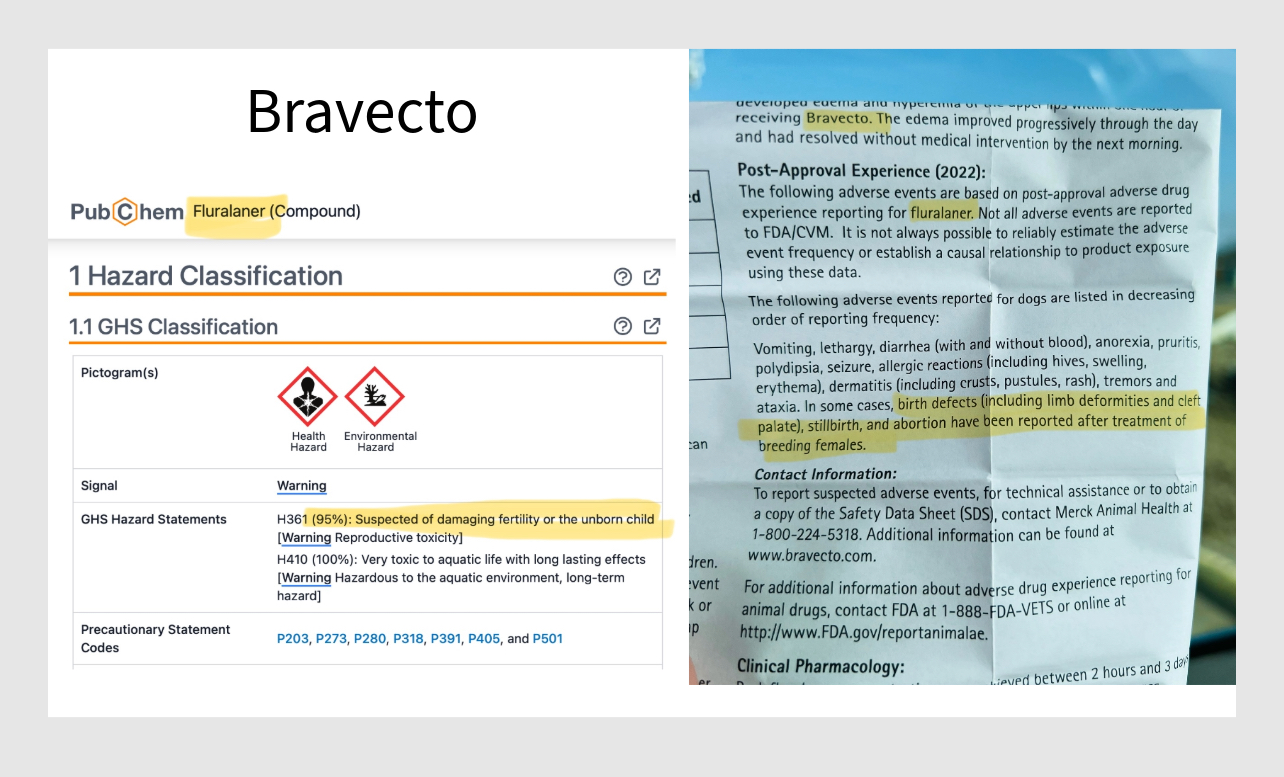
A rapid evidence assessment of the potential risk to the environment presented by active ingredients in the UK’s most commonly sold companion animal parasiticides.
Wells, C., Collins, C.M.T. Environ Sci Pollut Res 29, 45070–45088 (2022).
Scientific reviews show that there is very limited information on the environmental safety of fluralaner (Bravecto®, Exzolt®) and afoxolaner (NexGard®), despite how commonly they are used. Researchers found that ecotoxicity studies are largely missing, making it difficult to judge how these drugs affect the environment or non-target species. Fluralaner is known to be very persistent in soil and may be present in animal feces at levels that could harm insects, but no direct studies have been done. Afoxolaner is mainly excreted in feces as the original drug and its metabolites, yet its environmental concentration, persistence, and effects on wildlife are unknown. No invertebrate ecotoxicity data were provided for either drug in regulatory reports, with the exception that fluralaner has been shown to be toxic to Daphnia magna (a freshwater organism). Overall, the lack of environmental toxicity data severely limits confidence in the environmental safety of both fluralaner and afoxolaner.