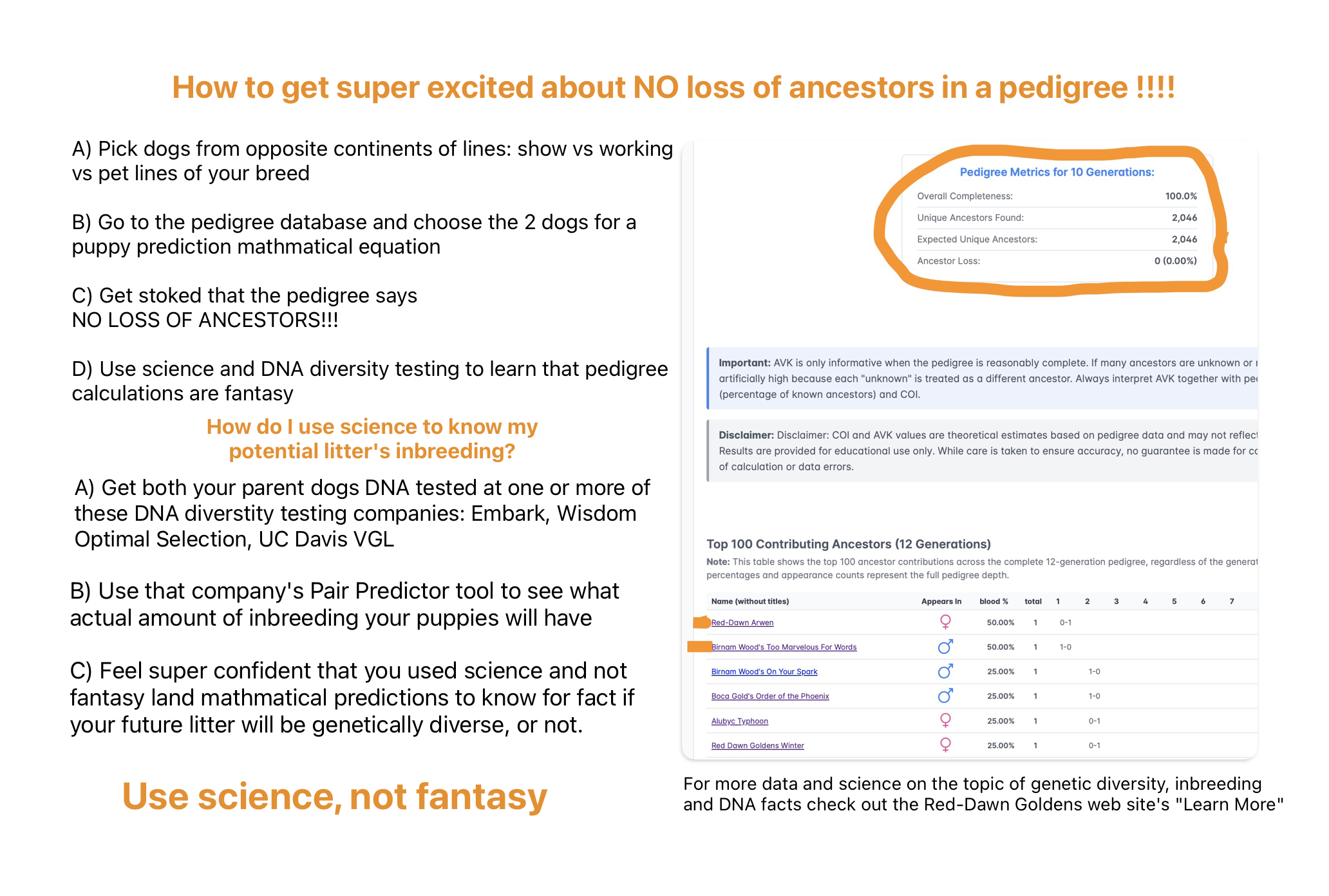
Pedigree calculations of inbreeding and ancestor loss is pure fantasy. Only DNA testing proves actual genetic diversity or inbreeding
The DNA tested inbreeding from Embark COI = 11% for these puppies. This is a real pairing of real dogs, bred by us, Red-Dawn. BOTH parents are each highly inbred, over 30% on DNA testing. But that is another article for another day…
The pedigree calculation says this litter is highly diverse and low inbreeding. Meaning this litter, on paper, this litter is 0% inbred. We know from DNA testing that the puppies are actually 11% COI.
Golden Retrievers can not get below about 10% COI on DNA testing. This is because all Goldens are more related than first cousins, or half siblings pairings. Most Goldens are as related as pairing full siblings, 25%.
Is looking at a pedigree a good method to know who the ancestors are?
Yes
If two pedigrees are matched and in 10 generations there are 2046 unique ancestors is that great?
Sure, except it is a complete lie in most purebred closed population breeds.
In this example two Golden Retrievers are paired together. They come from two continents of lines. On paper it appears there are no relatives in 10 generations. Yes, this IS true for the recent 10 generations.
Then what is the fantasy?
The full story is that the ancestors behind the 10 generations ARE related.
This means in a closed population (most purebreds) we cannot take just the past 10-12 generations and know the inbreeding IF the ancestors are all the exact same few dogs.
What do you mean by the ancestors of the 10 generations are related?
In the 10 generations of this pedigree it accurately shows 2046 unique dogs, no duplicates. This means in recent generations there has been no inbreeding. Sounds great right?!
BUT
What if the whole breed is made up of 9 dogs?
What if in the 11th to 15th generations the dogs Del, Steve, Preston, Larry, Art, Mindy, Donna, Sandy and Marcie are repeated as the majority of the ancestors?
Plus what if Larry, Mindy, Donna and Sandy are full siblings?
Plus what if Steve and Art are brothers?
This means the dogs in this past 10 generation pedigree are incredibly inbred, due to what happened 11-15 generations back. This story of using closely related family members as the foundation of a breed is common. Second, popular sires get overused and now subsequent generations are all highly inbred. Third, wars and breeding in a small sub-set of a country population also adds to inbreeding.
Many dog breeds have an effective population size under 20 dogs.
Ideally over 100 dogs is better.
The most well known study says our effective population size for Golden Retrievers is 6.5 dogs
Institute of Canine Biology, data on Golden Retrievers
Better Bred data on Golden Retrievers
What about DNA tested inbreeding vs pedigree calculations?
What this 10 generation pedigree does not show is the actual inbreeding of the puppies is still over 10% because Goldens are all at minimum 10% inbred, based on DNA testing of the population. The average Golden Retriever is 22% inbred. Many dogs from popular competitive lines are 30-40% inbred.
Here are the standard coefficients of inbreeding (COI) from a population who is NOT related to start
- First cousins 0.0625 (6.25%)
- Half siblings 0.125 (12.5%)
- Full siblings 0.25 (25%)
- Parent × child 0.25 (25%)
- Aunt × nephew (or uncle × niece) 0.125 (12.5%)
How can I learn more on DNA testing, pedigrees and science related to inbreed in dogs?
Check out our articles in our Learn More section here on Red-Dawn Goldens web site