Studies on Genetic Diversity
Mixed breed dogs lived about 1.2 years longer on average than size-matched purebred dogs. 9000 Golden Retrievers showed that inbreeding does negatively impact lifespan
Body size, inbreeding, and lifespan in domestic dogs. Yordy, J., Kraus, C., Hayward, J.J. et al., Conserv Genet 21, 137–148 (2020). https://doi.org/10.1007/s10592-019-01240-x
https://link.springer.com/article/10.1007/s10592-019-01240-x
Inbreeding is a major threat to many endangered species and captive breeding programs because it reduces genetic diversity and can weaken overall health and survival. Domestic dogs are a useful model for studying this because different breeds show large differences in inbreeding and lifespan. Researchers found that larger dog breeds tend to be more inbred than smaller breeds, but when comparing breeds of the same size, inbreeding didn’t explain lifespan differences. However, mixed-breed dogs lived about 1.2 years longer than size-matched purebred dogs, and individual data from over 9,000 Golden Retrievers showed that more inbred dogs tend to live shorter lives. The study also suggests that these inbreeding patterns are caused by breeding practices and limited founder populations, not by current population size. Overall, the results indicate that recent inbreeding within a breed is more harmful than older, historical inbreeding, and that occasional outcrossing (like mixed breeding) can significantly improve health and lifespan.
Inbreeding in Golden Retrievers and Reproduction
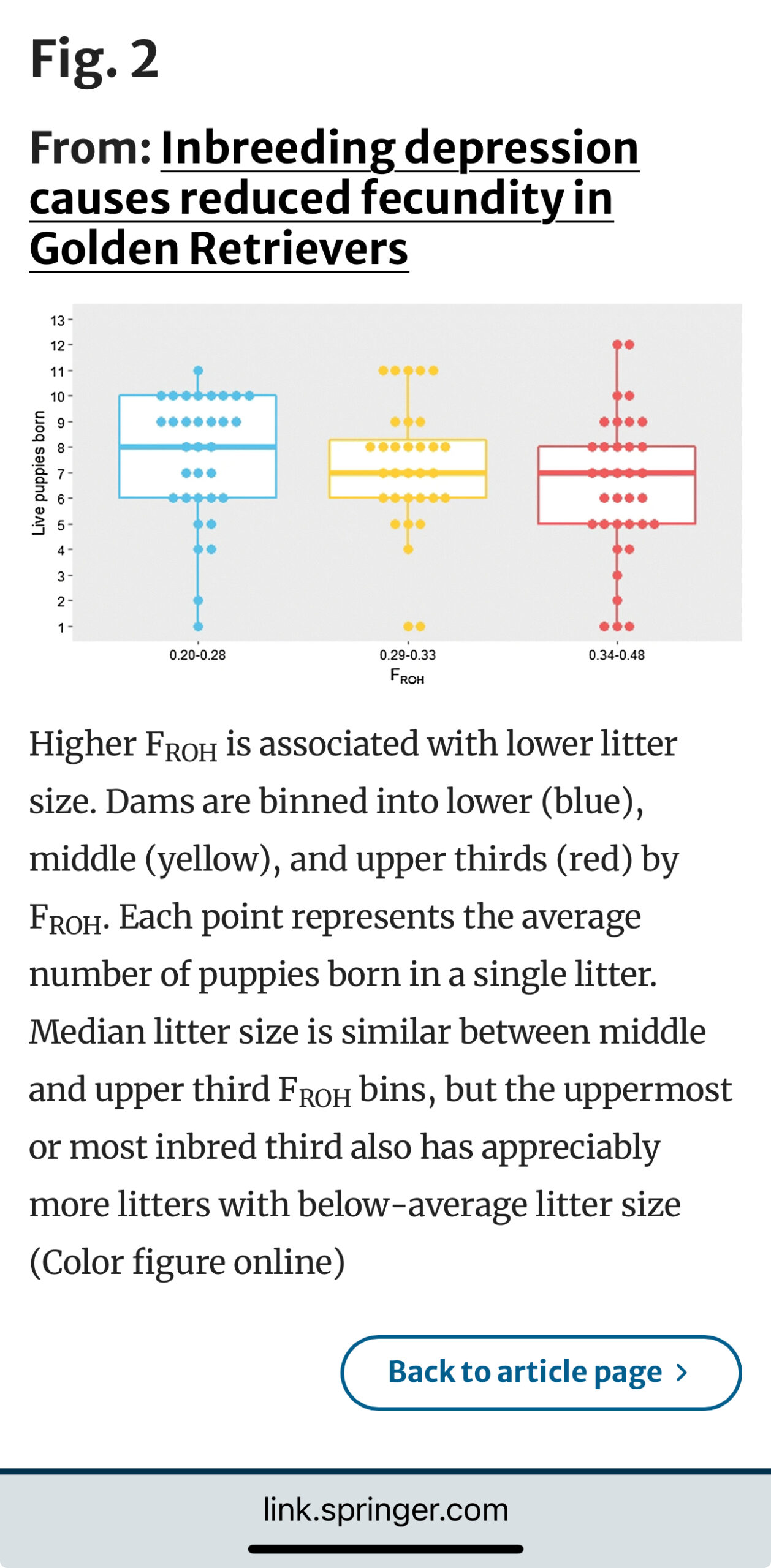
Inbreeding depression causes reduced fecundity in Golden Retrievers. Chu ET, Simpson MJ, Diehl K, Page RL, Sams AJ, Boyko AR., Mamm Genome 30, 166–172 (2019). https://doi.org/10.1007/s00335-019-09805-4
https://link.springer.com/article/10.1007/s00335-019-09805-4
Inbreeding has been shown to reduce health, reproduction, and overall performance in humans, wildlife (including endangered species), and more recently in domestic animals. To understand these long-term effects, researchers need consistent, high-quality health and reproductive data collected over time. Many scientists now prefer using DNA measures of inbreeding rather than traditional pedigree records because they are more accurate. In this study, researchers examined 93 Golden Retrievers from the Golden Retriever Lifetime Study and measured inbreeding using a genomic marker called FROH (Fraction of the Genome in Runs of Homozygosity). They found a clear and statistically significant relationship showing that dogs with higher levels of inbreeding had lower reproductive success. These results provide a foundation for larger studies to identify specific genetic regions linked to fertility and overall fitness. Embark DNA SNP genotyping was used for this study.
Loss of diversity in 12 pedigree purebred dog breeds in Sweden
Pedigree data indicate rapid inbreeding and loss of genetic diversity within populations of native, traditional dog breeds of conservation concern. Jansson M, Laikre L (2018) PLOS ONE 13(9): e0202849. https://doi.org/10.1371/journal.pone.0202849
https://journals.plos.org/plosone/article?id=10.1371/journal.pone.0202849
Inbreeding in Royal Kennel Club dogs
Trends in genetic diversity for all Royal Kennel Club registered pedigree dog breeds. Lewis, T.W., Abhayaratne, B. & Blott, S.C. Canine Genet Epidemiol 2, 13 (2015). https://doi.org/10.1186/s40575-015-0027-4
https://cgejournal.biomedcentral.com/articles/10.1186/s40575-015-0027-4
Repercussions of high frequency of inbreeding during the 1980’s and 1990’s in all Royal Kennel Club breeds. Significant increase in inbreeding occurred causing significant loss of genetic diversity.
Pedigree COI is far below DNA tested COI in dog breeds
Whole-genome sequence, SNP chips and pedigree structure: building demographic profiles in domestic dog breeds to optimize genetic-trait mapping. Dreger DL, Rimbault M, Davis BW, Bhatnagar A, Parker HG, Ostrander EA., Dis Model Mech. 2016 Dec 1;9(12):1445-1460. doi: 10.1242/dmm.027037. Epub 2016 Nov 17. PMID: 27874836; PMCID: PMC5200897.
https://pubmed.ncbi.nlm.nih.gov/27874836/
For a detailed overview of this study related to Golden Retrievers, read this article

Effects on genetic diversity on mortality
How size and genetic diversity shape lifespan across breeds of purebred dogs. Kraus, C., Snyder-Mackler, N. & Promislow, D.E.L. GeroScience 45, 627–643 (2023). https://doi.org/10.1007/s11357-022-00653-w
https://link.springer.com/article/10.1007/s11357-022-00653-w
Regarding effects on genetic diversity on mortality (summary is in the FDC library)
Using lifespan and cause-of-death data from over 40,000 dogs across 118 breeds, this study found that both smaller body size and greater genetic diversity are associated with significantly longer lifespans once bias from incomplete birth cohorts was removed. Dogs with higher genetic diversity and smaller size lived longer and experienced more deaths from old age rather than early mortality, while larger size increased cancer-related deaths. Overall, the findings support outcrossing as a way to improve breed health and longevity and highlight the importance of high-quality mortality data in veterinary research.
Higher inbreeding means worse health and shorter lifespan
The effect of inbreeding, body size and morphology on health in dog breeds. Bannasch, D., Famula, T., Donner, J. et al. Canine Genet Epidemiol 8, 12 (2021). https://doi.org/10.1186/s40575-021-00111-4
Overview by Charlie Clarke on Functional Dog Collaborative https://functionalbreeding.org/inherited-disorders-among-mixed-and-purebred-dogs/
Using DNA genetic inbreeding analysis, body weight, and insurance morbidity data from 227 dog breeds, this study examined how inbreeding and morphology relate to canine health. Higher inbreeding, larger body size, and deleterious conformations, particularly brachycephaly, were all associated with significantly higher morbidity and healthcare needs. Overall, smaller and less inbred breeds were healthier than larger, more inbred breeds.
One of the largest studies, by Bannasch et al. (2021), analyzed the genetic coefficient of inbreeding (COI) for 227 of the most common dog breeds. The researchers found that the average COI across these breeds was 0.249 (24.9%). To put this into perspective, a COI of 25% is what you would expect from a brother–sister mating in a population with no prior inbreeding. In other words, the average purebred dog today is genetically as similar as the offspring of two siblings.
Purebreds are more likely to be affected by disease
Frequency and distribution of 152 genetic disease variants in over 100,000 mixed breed and purebred dogs. Donner J, Anderson H, Davison S, Hughes AM, Bouirmane J, et al. (2018) PLOS Genetics 14(4): e1007361. https://doi.org/10.1371/journal.pgen.1007361
https://journals.plos.org/plosgenetics/article?id=10.1371/journal.pgen.1007361
Large scale DNA genetic screening of dogs shows that inherited disease risk is widespread across both purebred and mixed-breed populations, but it affects them differently. In a study of over 100,000 dogs, researchers found that about two out of five dogs carried at least one genetic disease variant from DNA analyst. Most disease causing genes were shared between purebreds and mixed breeds, but purebred dogs were significantly more likely to be genetically affected. Meaning they inherited two copies of a harmful gene while mixed breed dogs were more likely to be carriers with only one copy and no symptoms. This provides strong genetic evidence for “hybrid vigor,” where genetic diversity in mixed breeds reduces the chance of disease expression, even though they can still pass these genes on. The study also revealed previously unknown disease variants in additional breeds, highlighting how inbreeding and closed gene pools increase disease expression in purebreds, while mixed breeds tend to dilute these risks despite carrying similar mutations.
Greater occurrence of some genetic diseases in purebreds over mutts
Genetic Panel Screening of Nearly 100 Mutations Reveals New Insights into the Breed Distribution of Risk Variants for Canine Hereditary Disorders. Donner J, Kaukonen M, Anderson H, Möller F, Kyöstilä K, et al. (2016) PLOS ONE 11(8): e0161005.
https://doi.org/10.1371/journal.pone.0161005
Mongrel dogs had the highest life expectancy, followed by cross-bred dogs with only one purebred ancestor. Purebred dogs had the lowest life expectancy.
Investigating the relationship between inbreeding and life expectancy in dogs: mongrels live longer than pure breeds. Mata F, Mata A., PeerJ. 2023 Jul 19;11:e15718. doi: 10.7717/peerj.15718. PMID: 37483958; PMCID: PMC10362839.
https://pmc.ncbi.nlm.nih.gov/articles/PMC10362839/
This study tested whether dog health problems are linked to inbreeding. The results support this idea: mixed-breed dogs had the best survival rates, followed by dogs with only one purebred ancestor, while purebred dogs showed the highest levels of illness. Dogs with more health issues also had higher GISID (Genetic Inbreeding Score Index of Dogs) scores, which indicate more recessive genes and greater inbreeding. The study suggests that reducing inbreeding could improve dog health and survival, and recommends future research and breeding practices focus on lowering inbreeding levels and reducing harmful genes.
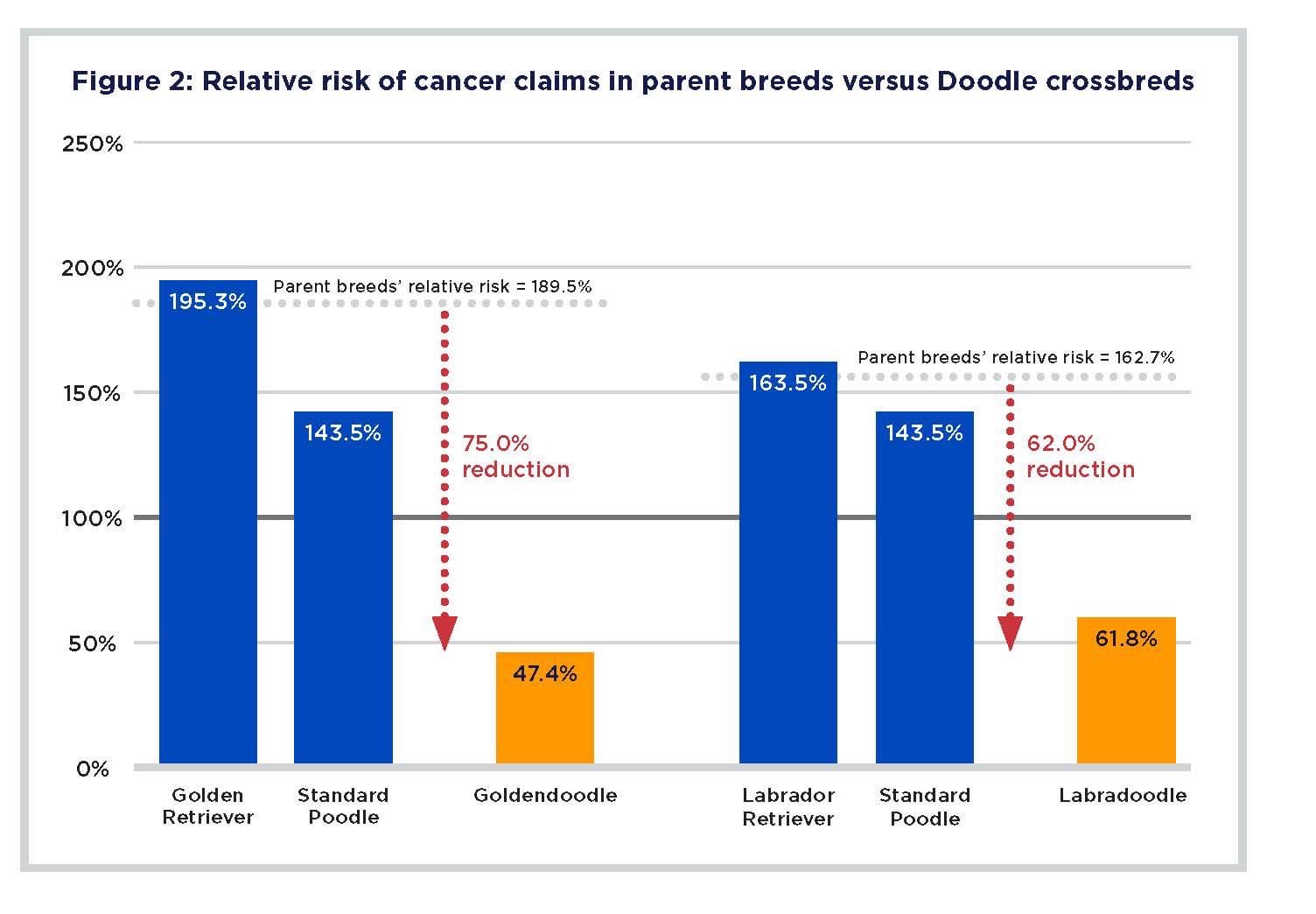
Doodles vs Purebred parent breeds cancer rate
https://news.nationwide.com/popular-poodle-cross-pups-outpacing-purebred-parents/
Significant reduction in cancer was found in dogs who are a blend of either Poodle with Labrador Retriever or Poodle with Golden Retriever. This is a gigantic population study utilizing the data from Nationwide’s Insurance claims. Total of 1.6 million dogs used for the cancer data in this study.
Inbreeding and cancer study
Genetic diversity, inbreeding and cancer. Ujvari B, Klaassen M, Raven N, Russell T, Vittecoq M, Hamede R, Thomas F, Madsen T., Proc Biol Sci. 2018 Mar 28;285(1875):20172589. doi: 10.1098/rspb.2017.2589. PMID: 29563261; PMCID: PMC5897632.
https://pubmed.ncbi.nlm.nih.gov/29563261/
Genetic diversity plays an important protective role against cancer, not just against infectious diseases. It highlights that low genetic diversity and inbreeding are associated with a higher cancer risk in both humans and animals, a link that has historically been under-studied compared to immunity and infections.
Inbreeding and lifespan
https://www.ncbi.nlm.nih.gov/pmc/articles/PMC7326369/#!po=0.657895
Body size, inbreeding, and lifespan in domestic dogs. Yordy J, Kraus C, Hayward JJ, White ME, Shannon LM, Creevy KE, Promislow DEL, Boyko AR. Conserv Genet. 2020 Feb;21(1):137-148. doi: 10.1007/s10592-019-01240-x. Epub 2019 Dec 5. PMID: 32607099; PMCID: PMC7326369.
This study shows that maintaining genetic diversity is critical when managing small or closely related populations, including endangered species and domestic animals. To reduce the harmful effects of inbreeding, breeding should be balanced so that no small group of females produces most of the offspring, especially in species with large litters. Occasionally breeding animals from different genetic groups can greatly improve overall health and resilience, as in cross-breeding. While past inbreeding can cause problems, these effects may lessen over time if harmful traits are not reinforced and further close inbreeding is avoided.
25 AKC breeds are far too inbred and have reduced immunity
Frequency and distribution of alleles of canine MHC-II DLA-DQB1, DLA-DQA1 and DLA-DRB1 in 25 representative American Kennel Club breeds. Angles JM, Kennedy LJ, Pedersen NC., Tissue Antigens. 2005 Sep;66(3):173-84. doi: 10.1111/j.1399-0039.2005.00461.x. PMID: 16101828.
https://pubmed.ncbi.nlm.nih.gov/16101828/
This study looked at immune system genes (called dog leukocyte antigens, or DLA) in 25 AKC dog breeds to see how much genetic diversity they have. These genes are important because they help dogs recognize and fight disease. The researchers found that while there is a wide variety of immune genes across all breeds combined, individual breeds have very limited diversity, meaning most dogs within a breed share the same immune gene types. Many immune gene variants were found in only one breed, and a large number of dogs were homozygous (having two identical copies of the same immune gene), which reduces immune flexibility. Some breeds were even monoallelic, meaning every dog tested had only one version of a key immune gene. When comparing North American dogs to European dogs, the study found that North American breeds had lost additional immune gene diversity, likely due to founder effects and breeding from a small number of original dogs. Overall, this means that purebred dogs often have restricted immune system diversity, which can make them more vulnerable to disease and autoimmune problems.
Mixed breeds living longer
Mortality of purebred and mixed-breed dogs in Denmark. Proschowsky HF, Rugbjerg H, Ersbøll AK., Prev Vet Med. 2003 Apr 30;58(1-2):63-74. doi: 10.1016/s0167-5877(03)00010-2. PMID: 12628771.
https://pubmed.ncbi.nlm.nih.gov/12628771/
Causes of death and age at death of 2928 dogs are reported from a questionnaire study among members of the Danish Kennel Club (DKC) in 1997. The dogs represented 20 breeds, 15 breed-groups and a group of mixed-breed dogs. The median age at death for all dogs in the study was 10.0 years. Mixed-breed dogs had a higher median age at death (11.0 years) than the entire population, but breeds like Shetland Sheepdog, Poodle and Dachshund exceeded this age (12 years). The Bernese Mountain Dog, the group of Molossian types and the Sighthounds had the shortest life span with a median age at death of 7.0 years. Old age was the most frequent reported cause of death (20.8%) followed by cancer (14.5%), behavioral problems (6.4%) accidents (6.1%), hip dysplasia (4.6%), heart diseases (4.6%) and spinal diseases (3.9%). Breed-specific proportional mortalities with 95% confidence limits are given for the six most prevalent specific causes of death.
Some purebreds have subgroups of increased inbreeding due to human choices
Variation in breeding practices and geographic isolation drive subpopulation differentiation, contributing to the loss of genetic diversity within dog breed lineages. Lampi S, Donner J, Anderson H, Pohjoismäki J., Canine Med Genet. 2020 Jun 9;7:5. doi: 10.1186/s40575-020-00085-9. PMID: 32835230; PMCID: PMC7386235.
https://pubmed.ncbi.nlm.nih.gov/32835230/
This study shows that dogs can become genetically divided not only between different breeds but also within the same breed, when breeders follow different “breed ideals” or when populations are separated by geography. Using DNA testing, researchers found distinct genetic subgroups in six breeds, especially in show lines, which are often bred for specific looks. This division leads to more inbreeding and less genetic diversity, which can harm the breed’s long term health. The study concludes that breeders should avoid creating unnecessary barriers between subgroups and should encourage more mixing between lineages and countries to keep the breed genetically healthy. It also warns that these hidden subgroups can cause misleading results in genetic studies if not taken into account.
Breeding of close relatives will reduce biological fitness through significant reduction of litter size and longevity.
Inbreeding impact on litter size and survival in selected canine breeds. Leroy G, Phocas F, Hedan B, Verrier E, Rognon X., Vet J. 2015 Jan;203(1):74-8. doi: 10.1016/j.tvjl.2014.11.008. Epub 2014 Nov 18. PMID: 25475165.
https://pubmed.ncbi.nlm.nih.gov/25475165/
Data obtained from the French Kennel Club and the Fichier National Canin were used to estimate the effect of inbreeding on average litter size and survival in seven French breeds of dog. Depending on the breed, litter sizes were 3.5–6.3 puppies and longevities were 7.7–12.2 years. Estimated heritabilities were 6.0–10.9% for litter size and 6.1–10.1% for survival at 2 years of age. Regression coefficients indicated a negative effect of inbreeding on both individual survival and litter size. Although the impact of baseline inbreeding within breeds appears to be limited, the improper mating of close relatives will reduce biological fitness through significant reduction of litter size and longevity.
Higher inbred dogs required more veterinary care
The Association between the Abundance of Homozygous Deleterious Variants and the Morbidity of Dog Breeds. Subramanian S, Kumar M., Biology (Basel). 2024 Jul 29;13(8):574. doi: 10.3390/biology13080574. PMID: 39194512; PMCID: PMC11351664.
https://pmc.ncbi.nlm.nih.gov/articles/PMC11351664/
It is well known that highly inbred dogs are more prone to diseases than less inbred or outbred dogs. This is because inbreeding increases the number of bad mutations present in both paternal and maternal chromosomes (recessive mutations) of the dogs. Using the genome data from 392 dogs belonging to 83 breeds, we investigated the association between the abundance of recessive bad mutations and dog health. The frequency of visits to veterinary clinics for non-routine care was used as the measure of dog health. Our results revealed a highly significant positive relationship between the number of recessive harmful mutations and the degree of dog health. The dog breeds that required more veterinary care had two times higher harmful mutations than those that required less care. The results of this study could be useful for understanding the disease burden on breed dogs and as a guide for dog breeding programs.
Human Studies on inbreeding
Inbreeding and risk of late onset complex disease. Rudan I, Rudan D, Campbell H, Carothers A, Wright A, Smolej-Narancic N, Janicijevic B, Jin L, Chakraborty R, Deka R, Rudan P., J Med Genet. 2003 Dec;40(12):925-32. doi: 10.1136/jmg.40.12.925. PMID: 14684692; PMCID: PMC1735350.
https://pmc.ncbi.nlm.nih.gov/articles/instance/1735350/pdf/v040p00925.pdf
This research shows that inbreeding in humans can increase the risk of many common diseases that appear later in life. The study found that people from a genetically isolated population who were more inbred had higher rates of conditions such as heart disease, stroke, cancer, depression, asthma, gout, and stomach ulcers, though type 2 diabetes was not affected. Inbreeding increases the chance that harmful recessive genes are inherited from both parents, which can disrupt normal body functions and raise disease risk. The researchers estimate that 23% to 48% of these diseases in the studied population were linked to recent inbreeding, suggesting a major global impact, especially since around one billion people worldwide live in communities where close-relative marriages are common.
Breed Specific Data
Doberman Diversity Project
https://www.dobermandiversityproject.org
- Health issues and decrease in vitality in Doberman Pinschers are due to inbreeding. This project’s goals are attempting to remedy this severe issue in Dobermans by DNA profiling dogs and adding in genetic diversity.
Cavalier Improvement Project
https://cavalierimprovement.com
-
- Our mission is to responsibly recreate a dog that embodies the beloved appearance and gentle temperament of the Cavalier King Charles Spaniel while prioritizing health, longevity, and genetic diversity. We are committed to eliminating the devastating health issues caused by extreme inbreeding in the breed’s modern population, with an outcross project. ** Links to science related to Cavaliers
Boxer + Corgi outcrossing project
https://www.instituteofcaninebiology.org/blog/the-catastrophe-of-cross-breeding-meet-the-borgis
- Dr. Bruce Cattanach in the UK did a breeding project with Boxers to get a natural bob tail. The primary outcome was a successful demonstration that a single dominant gene from the Pembroke Welsh Corgi could introduce a natural bobtail into the Boxer breed, providing a solution to the potential, and later implemented, ban on tail docking. After a few generations the dogs looked and acted like Boxers, yet had a natural bob tail.
Cross-Breeding Is Inevitable to Conserve the Highly Inbred Population of Puffin Hunter: The Norwegian Lundehund
Cross-Breeding Is Inevitable to Conserve the Highly Inbred Population of Puffin Hunter: The Norwegian Lundehund. Kettunen A, Daverdin M, Helfjord T, Berg P (2017) PLOS ONE 12(1): e0170039. https://doi.org/10.1371/journal.pone.0170039
https://journals.plos.org/plosone/article?id=10.1371/journal.pone.0170039
Show bred Scottish Terriers have shorter lifespans
- https://terriermandotcom.blogspot.com/2008/09/great-scott-thats-good-breed-health.html?m=1
- Great Scots Magazine, 1st Quarter 2013 Vol 18 no 1 pp 12-17 (Part 1)
https://scottishterrierhealth.com/wp-content/uploads/2013/04/big-truth.pdf
- Great Scots Magazine, 1st Quarter 2013 Vol 18 no 1 pp 18-22 and 44 (Part 2) https://scottishterrierhealth.com/wp-content/uploads/2013/04/big-truth-pt-2.pdf
Outcross strategies in Saarloos Wolfdogs
“Limits to genetic rescue by outcross in pedigree dogs.” Windig JJ, Doekes HP. , Anim Breed Genet. 2018 Jun;135(3):238-248. doi: 10.1111/jbg.12330. PMID: 29878495.
https://pubmed.ncbi.nlm.nih.gov/29878495/
This study estimated the effects of various outcross strategies in Saarloos Wolfdogs via computer simulations. They found that outcrossing must be performed regularly or continuously to sustainably increase genetic diversity throughout the population. A single outcross (especially when followed by backcrossing) is not enough! This study also found that outcrossing only rarely introduces harmful traits into the population, and more commonly introduces beneficial traits.
Overview by Noah Stetson