What should puppy buyers know about inbreeding in purebred dogs?
Many people assume that buying a purebred dog means buying a healthier or more predictable dog. Are purebreds more predictable than a mutt? Yes, purebreds have that corner of the market covered. That is what attracts us to pure breeds. We want predictable traits.
However, scientific research shows that high levels of inbreeding are widespread in purebred dogs, and this can have serious health consequences.
Multiple genetic studies have examined how closely related dogs are within their breed (Dreger et al. 2016; Donner et al. 2018; Bannasch et al. 2021; Mata and Mata 2023 Subramanian and Kumar 2024). These studies consistently show that inbreeding is common across most dog breeds.
In one of the largest studies of canine inbreeding, Bannasch et al. (2021) analyzed DNA heterozygosity data from 49,378 dogs representing 227 breeds and varieties, including mixed breeds. Researchers used these results to estimate genetic inbreeding coefficients (Fadj), with an average of 217.5 dogs tested per breed and sample sizes ranging from 30 to 2,520 dogs per breed (reported in the Methods section).
The researchers found that the average COI across these breeds was 0.249 (24.9%). To put this into perspective, a COI of 25% is what you would expect from a brother–sister mating in a population with no prior inbreeding. The average breed’s estimated inbreeding is about the level expected from a full-sibling mating.
You might think this average is skewed by just a few extremely inbred breeds, but the data show otherwise. According to Bannasch et al. (2021) the estimated averages:
• 108 breeds have an average COI of 25% or higher (the level of full sibling mating)
• 47 breeds are closer to 25% than to 12.5% (the level of a half-sibling mating)
• 46 breeds are above 12.5%, though not closer to 25%
• 16 breeds are closer to 12.5% than to 6.25% (the level of a cousin mating)
• Only 8 breeds are just above cousin-level inbreeding (6.25%): Australian Labradoodle (6.4%), Bolognese (9.0%), Danish-Swedish Farm Dog (7.9%), Koolie (7.9%), Kritikos Lagonikos (7.5%), Norrbottenspets (9.0%), Parson Russell Terrier (7.9%), and Tamaskan Dog (8.5%)
The Rat Terrier (6.0%), averaged below cousin-level inbreeding.
For comparison, mixed-breed dogs averaged a much lower COI of 3.7%, well below cousin-level inbreeding (Bannasch et al. 2021, appendix). Earlier research found similar results (Dreger et al. 2016; Beuchat 2016).
While it is encouraging that a small number of breeds have lower inbreeding levels, the overall picture is concerning. According to pedigree estimate standards such as those used by the Swedish Kennel Club, cousin-level inbreeding (6.25%) is often considered the maximum acceptable limit. Unfortunately, pedigree-based COI calculations using only 5–12 generations can substantially underestimate a dog’s true genomic inbreeding, sometimes by as much as 5 to 10 times. This happens because older generations of shared ancestry are excluded. DNA-based testing provides a more complete picture of the inbreeding a dog has actually inherited.
Bannasch et al. (2021) found that most purebred dog breeds have inbreeding levels above 10%, a level considered extremely high in other species and associated with concerns about inbreeding depression.
The authors cited Meagher et al. (2000), who found a 57% reduction in overall fitness in mice with 25% inbreeding, and Rudan et al. (2003), who associated even 3–6% inbreeding in humans with increased risks of certain complex diseases.
Although these findings cannot be directly applied to dogs, they raise important concerns about how high levels of inbreeding may contribute to health problems, including cancers and autoimmune diseases.
Sources:
Bannasch et al. (2021):
https://doi.org/10.1186/s40575-021-00111-4
Meagher et al. (2000): Male-male competition magnifies inbreeding depression in wild house mice.
Rudan et al. (2003): Inbreeding and the genetic complexity of human hypertension.
How do I get a puppy who is not inbred?
For puppy buyers, the wide-spred inbreeding highlights why it is important to look beyond labels like “purebred” and to ask breeders informed questions.
Ask questions about DNA tested genetic diversity, disease testing and not just pedigree papers with pedigree analysis of inbreeding. The pedigree will NOT show the compounded genetic inbreeding of Golden Retrievers, or most dog breeds.
Purebred dogs are far more inbred than what a pedigree shows in the typical 12 generation pedigree analysis. Why? Because the ancestors are all also closely related. Learn more on his subject where we documented DNA tested inbreeding vs Pedigree inbreeding of our Golden Retrievers.
Are there any Golden Retrievers who are less inbred?
In some breeds we can reduce the inbreeding by pairing dogs from opposite gene pools. As and example, this can be achieved in Golden Retrievers by pairing a dog from European show lines with American hunting lines. Due to both families of dogs not sharing any ancestors for many decades, the inbreeding can greatly reduce in the puppies. But, this method does not apply to all breeds, especially small population breeds where all dogs in the world are closely related.
As of 2026, three genetic testing platforms offer tools to evaluate the genetic compatibility of two prospective breeding dogs and help predict genetic diversity or inbreeding in their potential offspring:
Embark DNA: Uses genome-wide SNP testing to measure genetic inbreeding (COI), diversity and inherited diseases, with Pair Predictor estimating the COI of future puppies.
UC Davis VGL / BetterBred: Uses STR markers to evaluate genetic diversity, DLA haplotypes and relatedness between potential breeding pairs, but does not directly predict genomic COI.
Wisdom Panel Optimal Selection: Uses genome-wide SNP testing to evaluate genetic diversity, inherited diseases and traits, with Litter Predict helping breeders assess potential offspring.
Learn more about the options of genetic diversity testing.
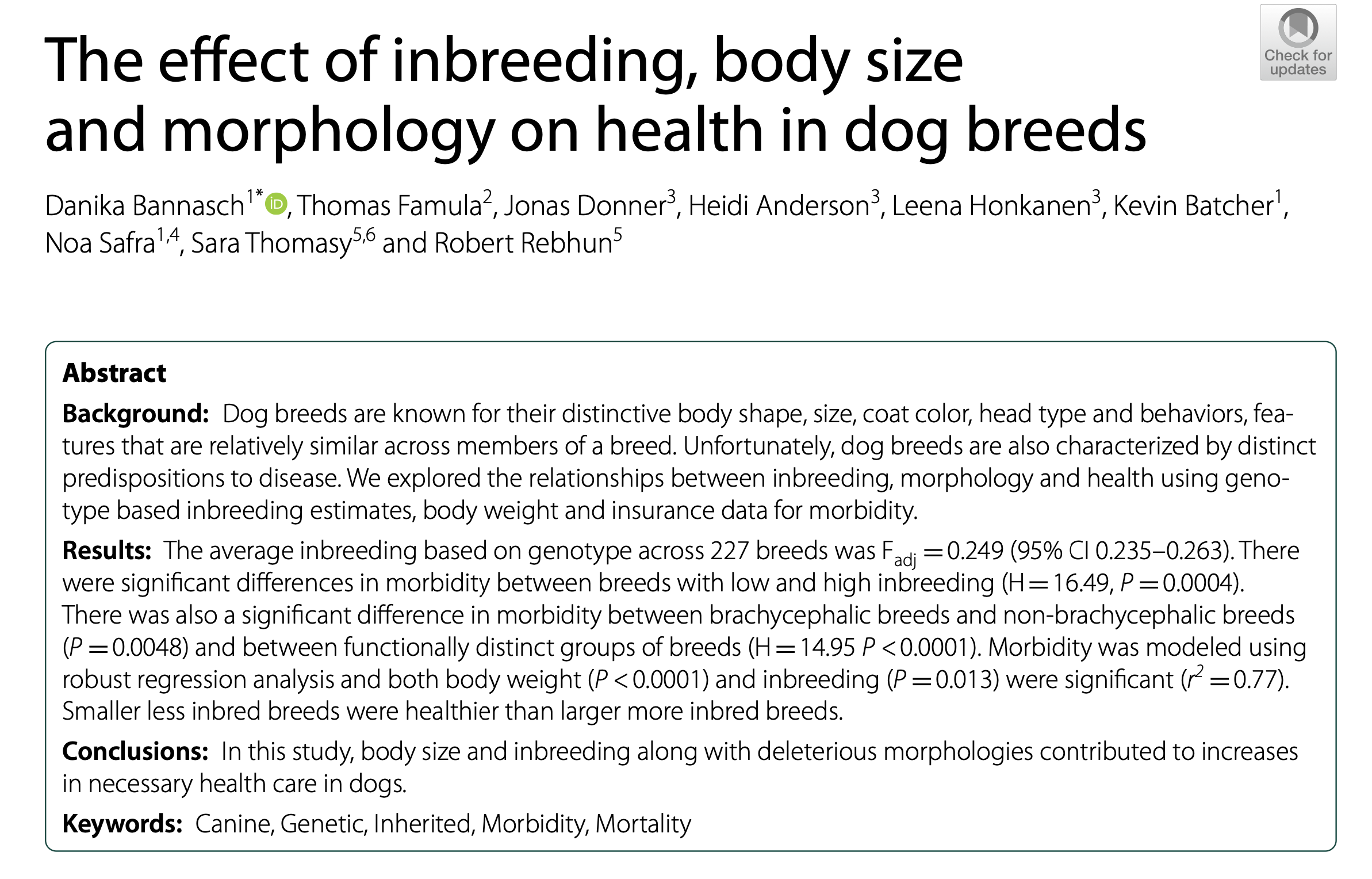
The effect of inbreeding, body size and morphology on health in dog breeds by Danika Bannasch et. al., 2021
Full study link:
Bannasch D, Famula T, Donner J, Anderson H, Honkanen L, Batcher K, Safra N, Thomasy S, Rebhun R. The effect of inbreeding, body size and morphology on health in dog breeds. Canine Med Genet. 2021 Dec 2;8(1):12. doi: 10.1186/s40575-021-00111-4. PMID: 34852838; PMCID: PMC8638537.
The effect of inbreeding, body size and morphology on health in dog breeds by Danika Bannasch et. al., 2021
Golden Retriever (Show) — Dataset 2
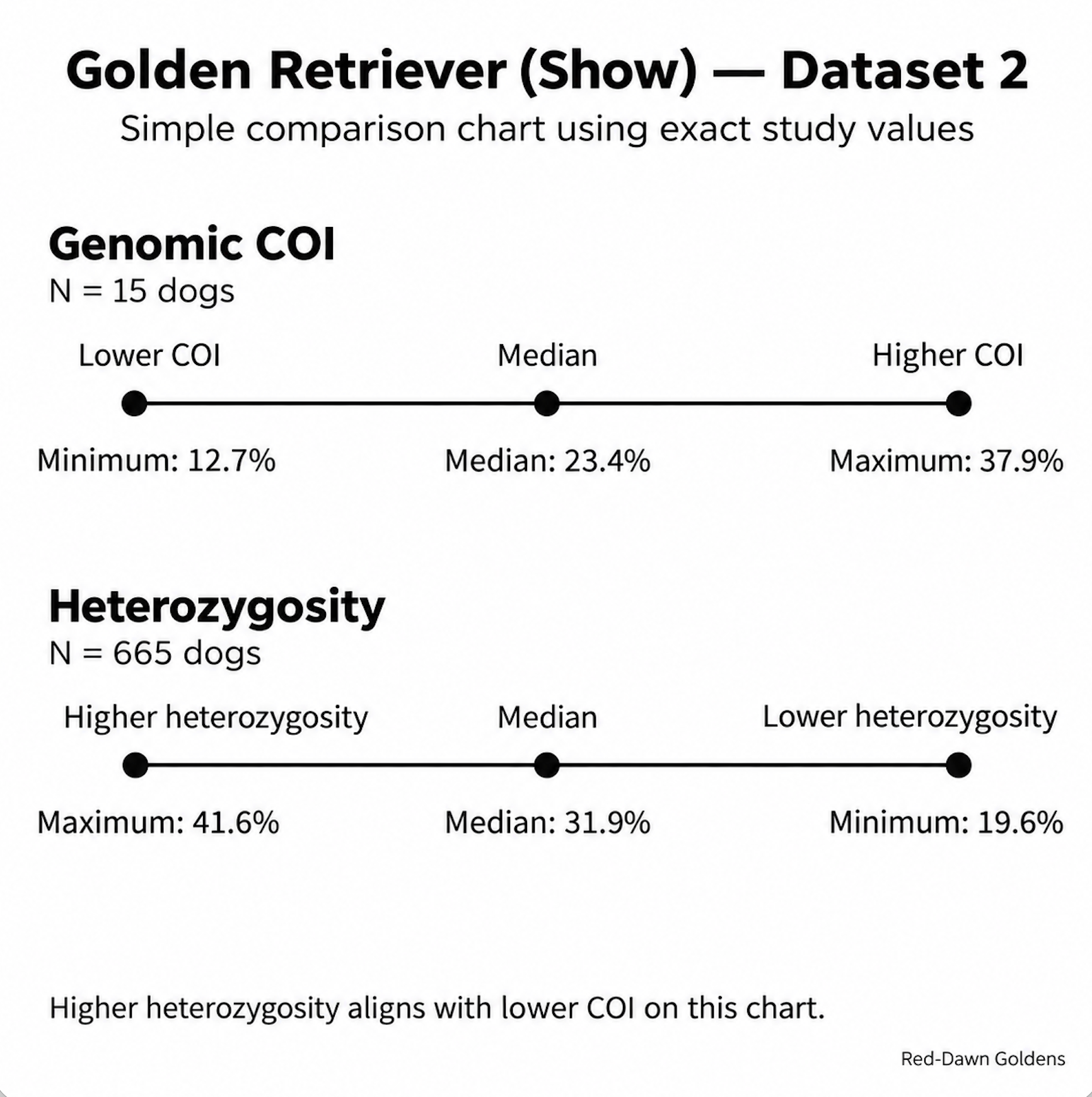
Simple chart showing Golden Retriever (Show) Dataset 2 results from Bannasch et al. (2021), comparing genomic COI and heterozygosity. The chart shows COI data from 15 dogs and heterozygosity data from 665 dogs, with minimum, median, and maximum values displayed on matching lines so that lower COI aligns with higher heterozygosity.
Bannasch et al. (2021), genomic inbreeding and heterozygosity results.
| Category | Golden Retriever Results |
|---|---|
| Breed | Golden Retriever (Show) |
| Number tested for genomic COI (N) | 15 dogs |
| Median COI (F Median) | 23.4% |
| Minimum COI (F Minimum) | 12.7% |
| Maximum COI (F Maximum) | 37.9% |
| Number tested for heterozygosity (N) | 665 dogs |
| Median heterozygosity | 31.90% |
| Minimum heterozygosity | 19.60% |
| Maximum heterozygosity | 41.60% |
Important distinctions:
-
COI measures genomic inbreeding. Higher percentages indicate more inbreeding under this study’s measurement method.
-
Heterozygosity measures genetic variation at the tested markers. Higher percentages generally indicate greater genetic diversity.
-
The 15 Golden Retrievers evaluated for direct genomic COI and the 665 evaluated for heterozygosity represent two different datasets.
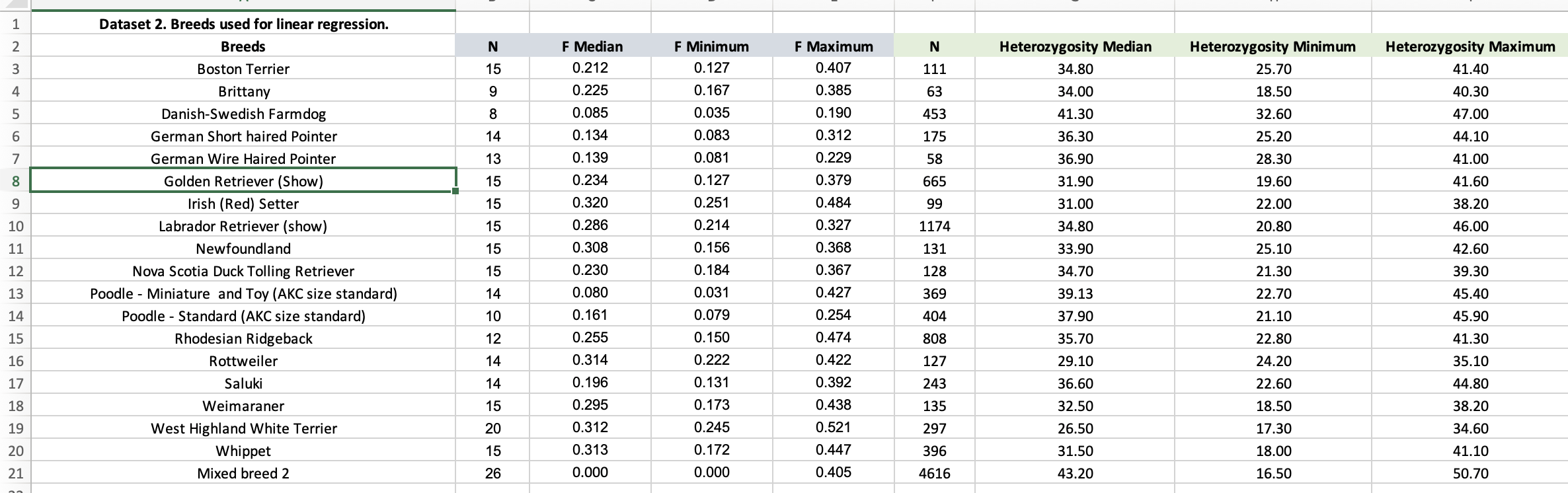
In the 2021 Bannasch study, researchers directly measured genomic inbreeding in 15 show line Golden Retrievers. The median COI was 23.4%, with individual dogs ranging from 12.7% to 37.9%. A separate sample of 665 Golden Retrievers was evaluated for heterozygosity, a measure of genetic diversity. These findings demonstrate considerable variation in genetic inbreeding among Golden Retrievers and show why DNA testing individual breeding dogs is more informative than relying solely on a breed average.
What Dataset 1 Tells Us About Inbreeding in Purebred Dogs
Bannasch et al. (2021) examined genetic diversity across 227 dog breed categories, using DNA data from 49,378 dogs to estimate breed levels of inbreeding.
The main findings:
-
High inbreeding is widespread. The average estimated COI across the 227 breed categories was 24.9%, with many breeds exceeding 30% or even 40%.
-
Inbreeding varies substantially between breeds. The estimated COI values shown range from approximately 6% to more than 50%, demonstrating considerable differences in genetic diversity.
-
Higher inbreeding was associated with poorer health outcomes. Researchers compared estimated breed inbreeding with Swedish veterinary insurance data and found an association between greater inbreeding and increased nonroutine veterinary care.
-
Body size and physical characteristics also matter. Larger dogs and breeds with brachycephalic (shortened muzzle) conformation experienced additional health risks independent of inbreeding.
-
These are breed estimates, not individual dog measurements. Researchers used DNA heterozygosity and a statistical model to estimate COI. Individual dogs within each breed may have substantially different inbreeding levels.
-
49,378 DNA tested dogs
-
227 breeds or varieties
-
An average of 217.5 dogs per breed
-
Between 30 and 2,520 dogs per breed, according to the Methods section
-
What the spreadsheet columns mean
| Column | What it measures |
|---|---|
| F_adj | Estimated breed genomic inbreeding coefficient (COI) |
| Count for Insurance Data | Approximate number of dogs represented in the insurance records |
| Morbidity | Nonroutine veterinary care events per 10,000 insured dog years |
| Brachycephaly | Whether the breed was classified as short muzzled |
| FCI Group | Breed classification |
These pictures of Dataset 1 show all of the 227 dog breeds analyzed in the study: The effect of inbreeding, body size and morphology on health in dog breeds. Bannasch et. al. 2021
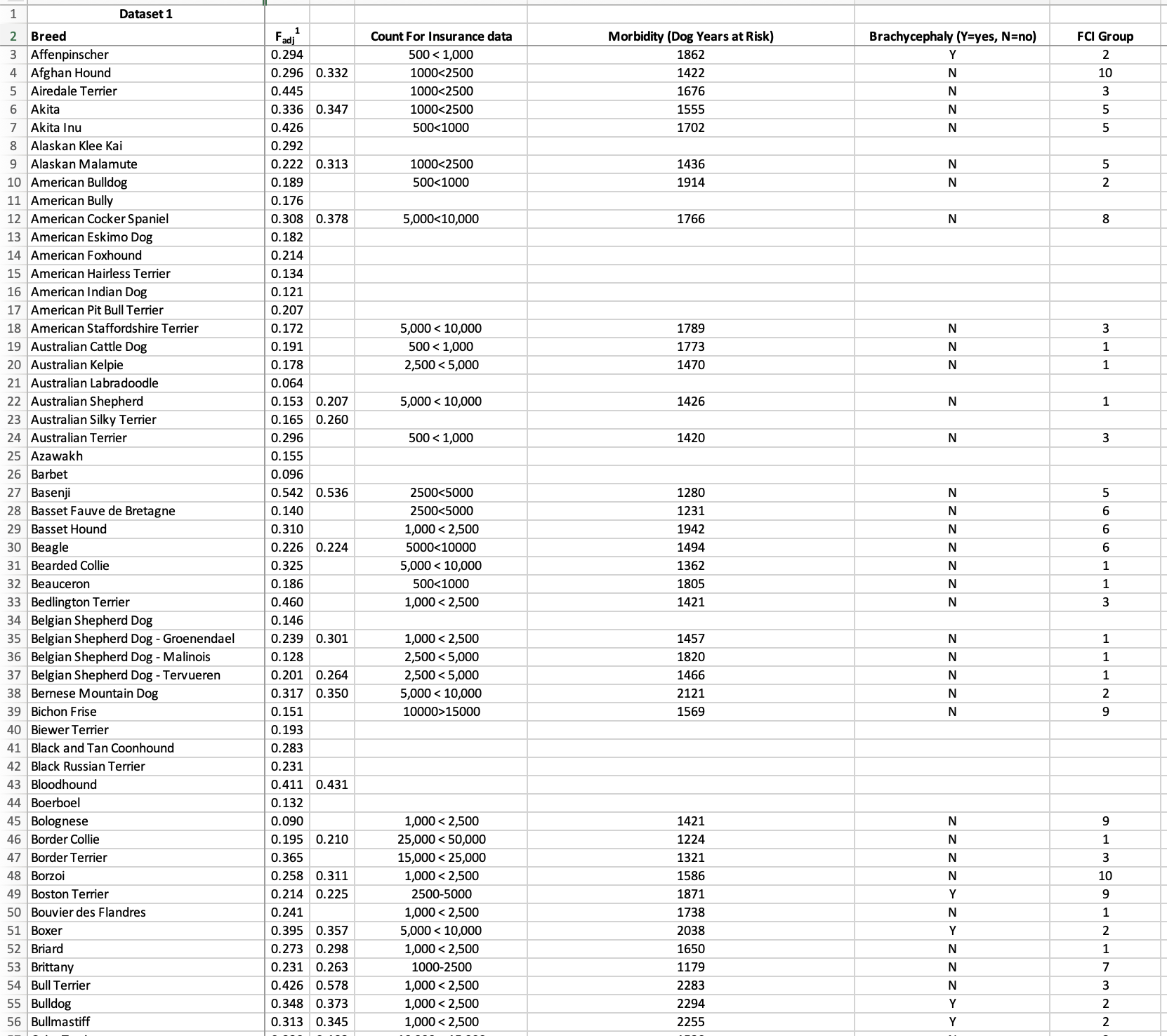
Bannasch et al. (2021) dog inbreeding study showing estimated genetic COI, veterinary morbidity data, and breed classifications for breeds alphabetically from Affenpinscher through Bullmastiff (A–B).
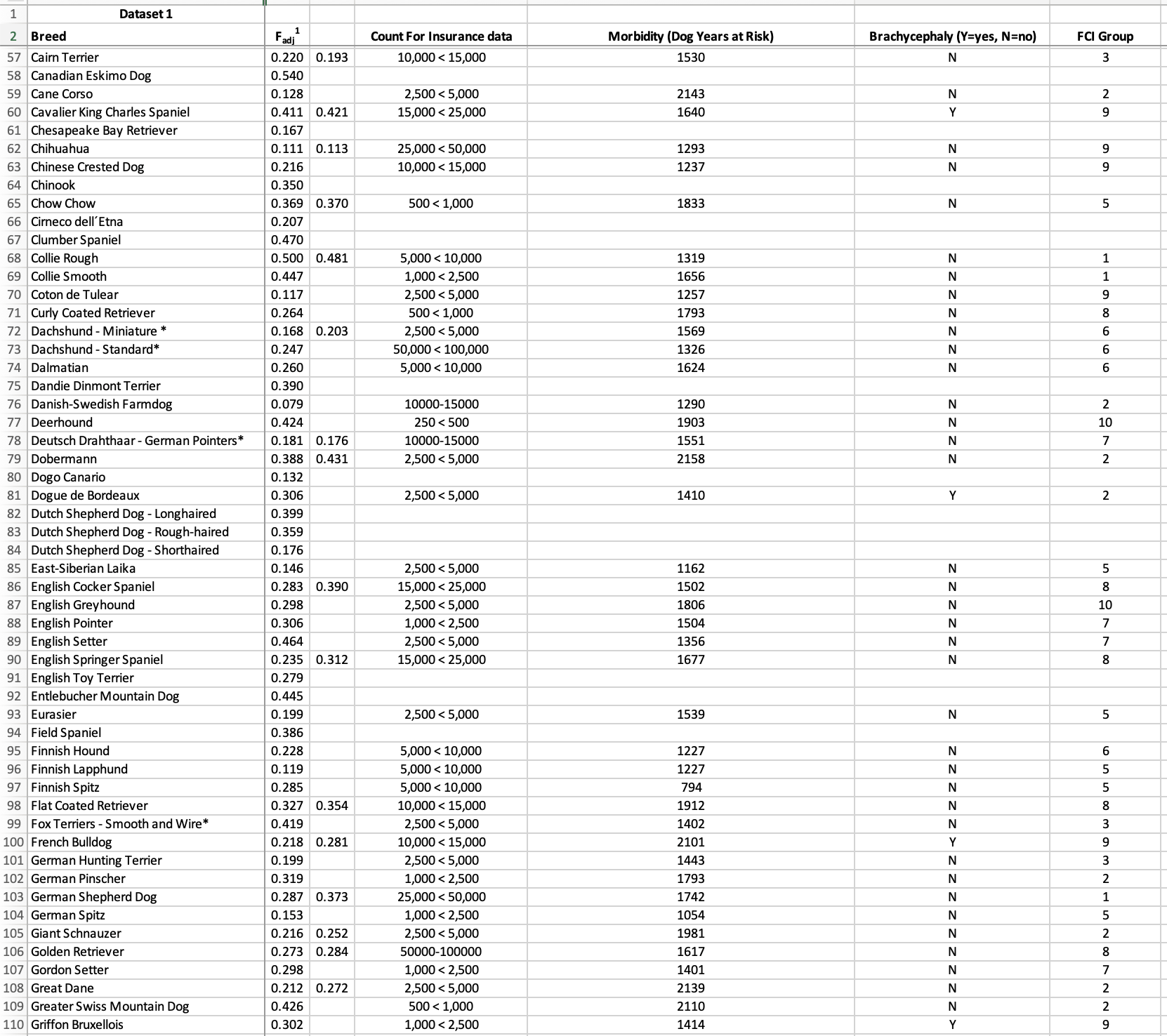
Bannasch et al. (2021) dog inbreeding study showing estimated genetic COI, veterinary morbidity data, and breed classifications for breeds alphabetically from Cairn through Griffon Brussels (C-G).
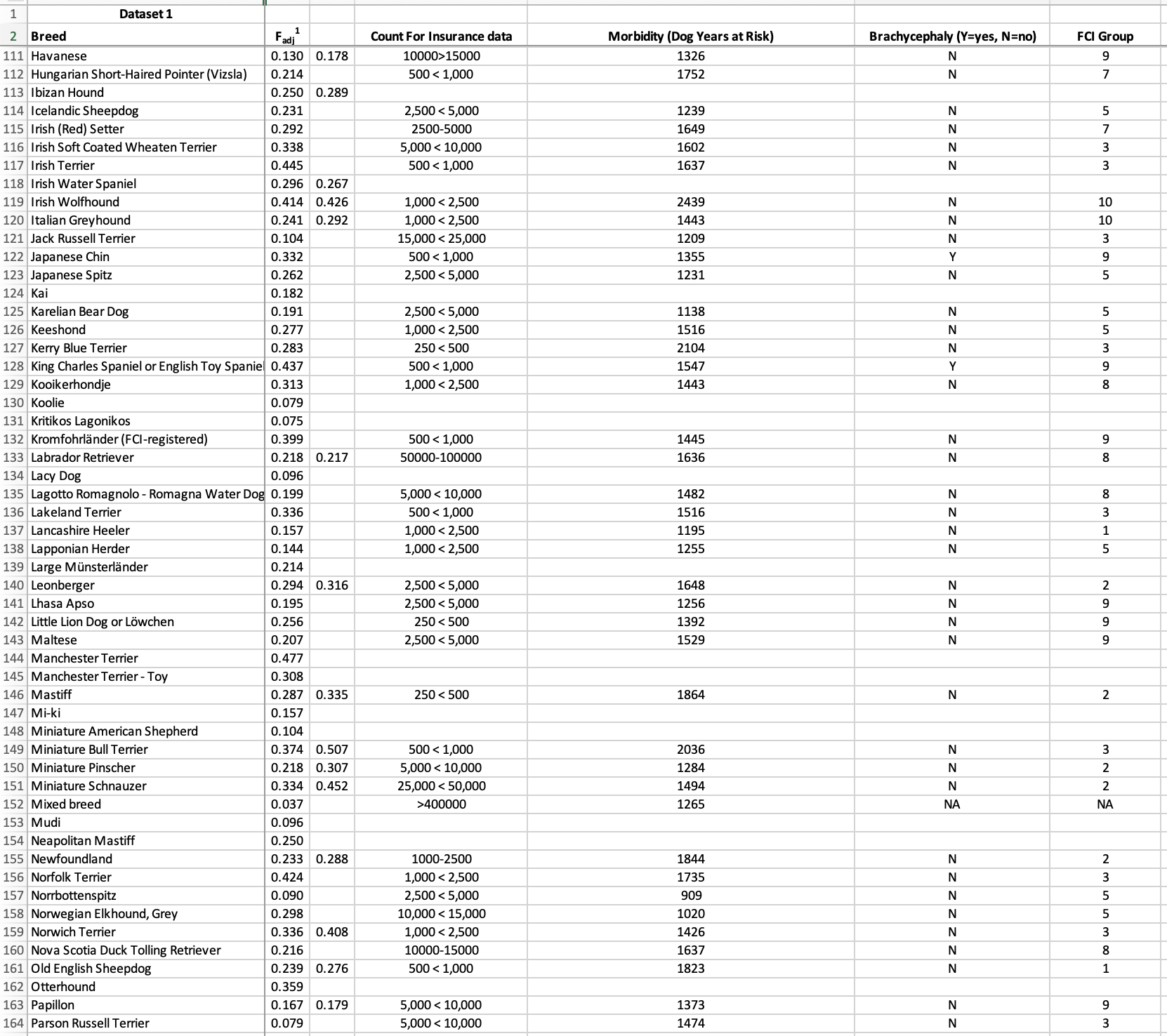
Bannasch et al. (2021) dog inbreeding study showing estimated genetic COI, veterinary morbidity data, and breed classifications for breeds alphabetically from Havanese through Parson Russell Terrier (H–P).
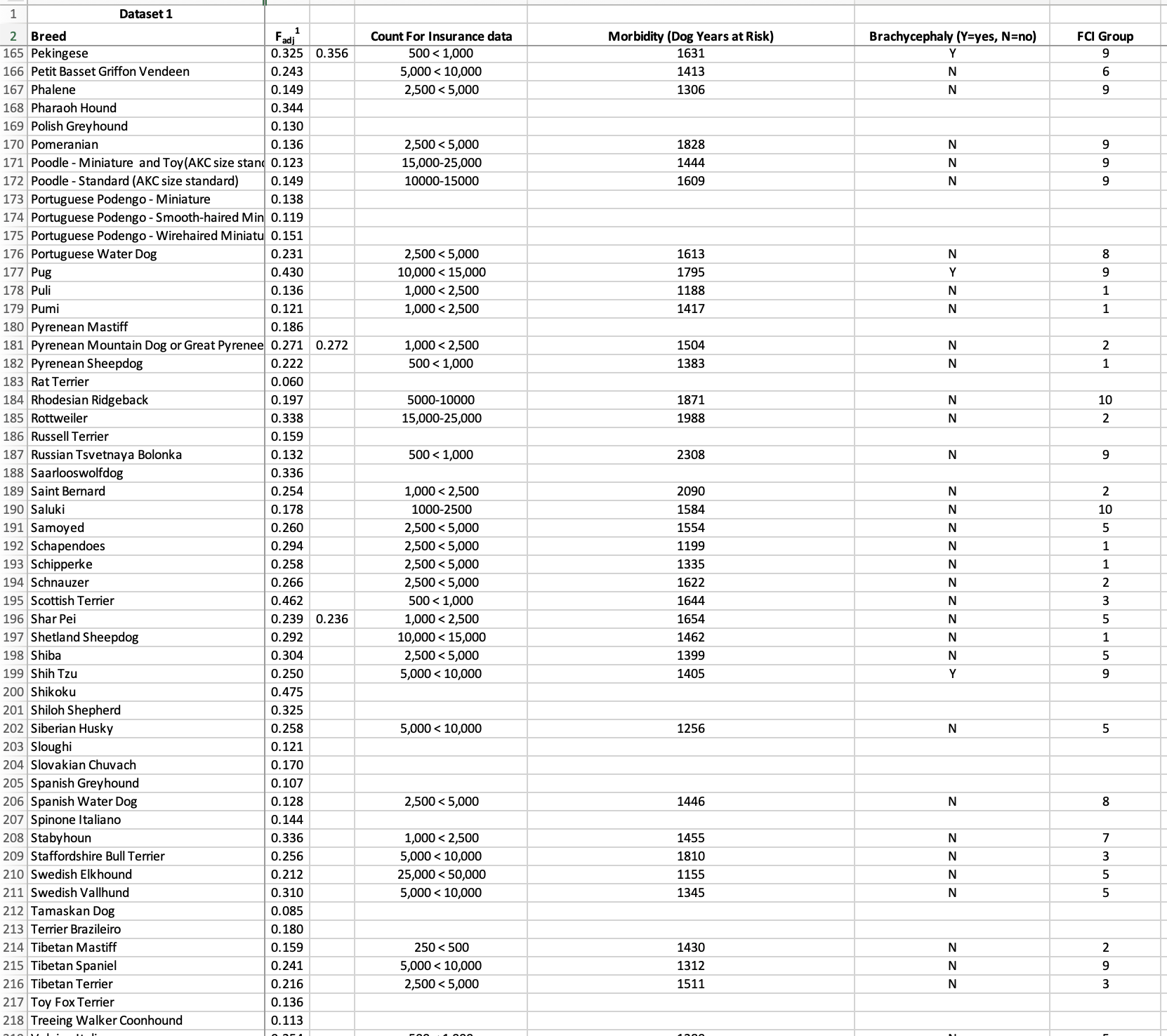
Bannasch et al. (2021) dog inbreeding study showing estimated genetic COI, veterinary morbidity data, and breed classifications for breeds alphabetically from Pekingese through Treeing Walker Coonhound (P–T).
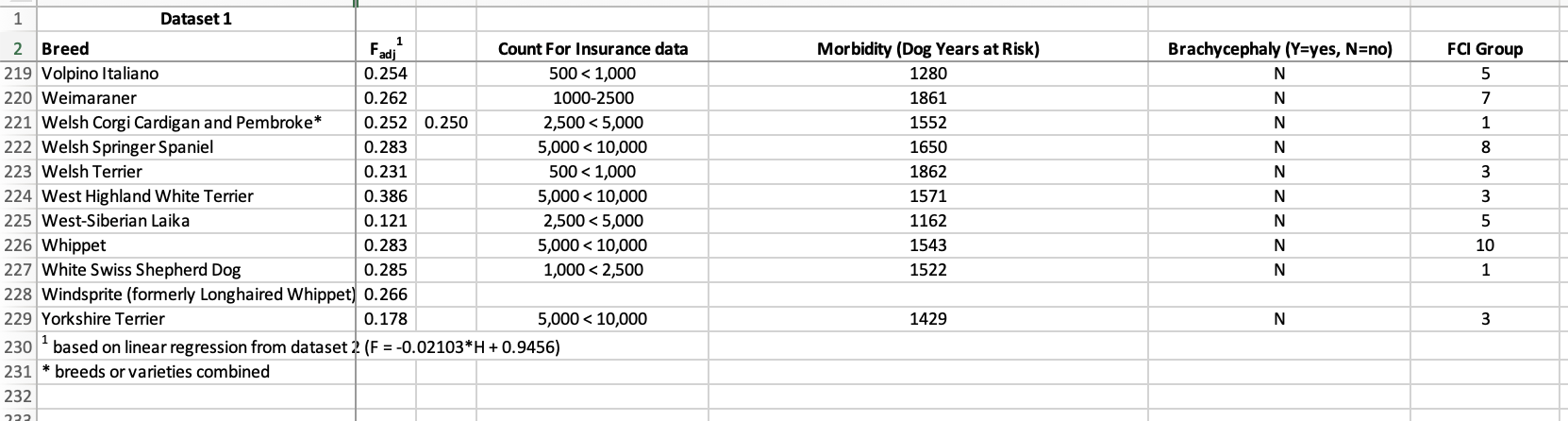
Bannasch et al. (2021) dog inbreeding study showing estimated genetic COI, veterinary morbidity data, and breed classifications for breeds alphabetically from Volpino Italiano through Yorkshire Terrier (V–Y).