
Nationwide Insurance examined 1,612,884 insured dogs over six years, including tens of thousands of Goldendoodles and Labradoodles. Both Doodle populations had substantially lower cancer claim risk than their contributing purebred breeds.
Golden Retriever vs. Goldendoodle Cancer Claim Risk
With the average dog’s cancer claim risk set at 100%, Nationwide reported:
| Dog population | Relative cancer claim risk |
|---|---|
| Golden Retriever | 195.3% |
| Labrador Retriever | 163.5% |
| Standard Poodle | 143.5% |
| Labradoodle | 61.8% |
| Goldendoodle | 47.4% |
Calculated from these figures, Goldendoodles had approximately 76% lower cancer claim risk than Golden Retrievers and 67% lower risk than Standard Poodles. Labradoodles had approximately 62% lower risk than Labrador Retrievers.
Nationwide’s combined parent breed comparisons showed a 75% reduction for Goldendoodles and a 62% reduction for Labradoodles.
These percentages measure relative insurance claim risk. A value of 195.3% means about 1.95 times the average claim risk, rather than a 195.3% lifetime probability of developing cancer.
Mixed Breed Dogs Also Had Lower Risk Within Every Size Group
Nationwide’s follow up paper, About the Size of It: Scaling Canine Cancer Risk, compared purebred and mixed breed dogs within four size categories.
| Size category | Lower cancer claim risk in mixed breed dogs |
|---|---|
| Toy | 60.6% |
| Small | 54.7% |
| Medium | 52.5% |
| Large + extra large | 50.4% |
The difference remained across all four size groups. This strengthens the evidence that the overall gap cannot be explained simply by comparing large purebreds with small mixed breed dogs. These Nationwide papers are analyses of the same underlying insurance population, rather than independent replications.
What Trupanion’s Breed Charts Show
The supplied Trupanion charts highlight selected commonly claimed conditions by life stage.
For Golden Retrievers, the chart lists:
- Senior lymphoma claims at 2.5 times the chart’s average dog benchmark.
- Senior osteosarcoma claims at 2.5 times that benchmark.
- Adult mast cell neoplasm claims 25% above the benchmark.
For Goldendoodles, the chart lists:
- Senior mast cell neoplasm claims 45% above its average dog benchmark.
- Adult mass claims 10% above the benchmark.
- Senior mass claims about equal to the benchmark.
Lymphoma and osteosarcoma do not appear among the selected Goldendoodle conditions. Their omission does not establish their frequency, but it does mean it is not the most common condition in the claims. Also, a claim described as a “mass” does not necessarily mean cancer, and the mast cell comparisons apply to different life stages.
Why Genetic Diversity Matters
Genetic diversity deserves serious consideration in breeding decisions. Research by Bannasch and colleagues found that greater inbreeding was associated with greater overall veterinary care needs across dog breeds.
The supplied Golden Retriever graphic brings together inbreeding estimates from several sources. Its figures vary with the dogs sampled and the measurement method, so they should not be treated as interchangeable or as one universal breed average.
Crossing a Golden Retriever with a genetically distinct Poodle can substantially reduce offspring inbreeding. A specific 0% to 5% result should be established through genetic testing or a suitable pairing prediction, rather than assumed for every Goldendoodle.
Nationwide’s data show a substantial cancer claim advantage for these Doodle populations. They support investigating genetic diversity as a contributor, but do not isolate its causal effect: the original Doodle analysis did not control for age, size, obesity or other potential influences.
Sources
- Nationwide: Oodles of Doodles: Popularity and Health, January 2022.
- Nationwide: About the Size of It: Scaling Canine Cancer Risk, June 2022.
- Trupanion: Commonly Claimed Conditions, Golden Retriever and Goldendoodle charts supplied with this article.
- Bannasch et al.: The Effect of Inbreeding, Body Size and Morphology on Health in Dog Breeds, 2021.
- Embark: Why Should Breeders Consider Genetic COI in Breeding Decisions?
-
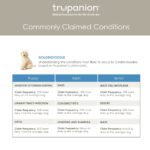
- Goldendoodle claims: Trupanion lists senior mast cell neoplasm claims 45% above its average dog benchmark, adult mass claims 10% above average, and senior mass claims about average. Lymphoma and osteosarcoma are not listed; their absence alone does not establish their frequency.
-
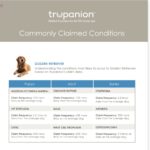
- Golden Retriever claims: Trupanion lists senior lymphoma and osteosarcoma claims at 2.5 times its average dog benchmark, adult mast cell neoplasm claims 25% above average, and adult mass claims 40% above average.
-
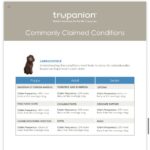
- Labradoodle claims: Trupanion highlights digestive problems, ear infections, conjunctivitis, cruciate rupture, lipomas, and masses. A lipoma is a benign fatty tumor, and a mass does not necessarily mean cancer.
-
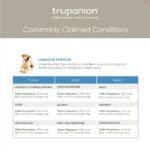
- Labrador Retriever claims: Trupanion lists adult mast cell neoplasm claims 60% above its average dog benchmark and senior osteosarcoma claims at twice the benchmark. Other listed conditions include ear infections, allergies, hip dysplasia, arthritis, and cruciate rupture.
-
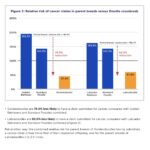
- Nationwide found Goldendoodles had 75% lower cancer claim risk than Golden Retrievers and Standard Poodles combined. Labradoodles had 62% lower risk than Labradors and Standard Poodles combined.
-
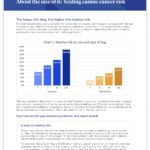
- Dog cancer risk increases with size: Nationwide’s chart shows cancer claim risk rising with body size in both purebred and mixed breed dogs. Mixed breed dogs had lower risk than purebreds within every size category.
-
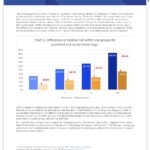
- Dog cancer risk within size groups: Nationwide found mixed breed dogs had lower cancer claim risk than purebreds in every size category: 60.6% lower in toy dogs, 54.7% in small dogs, 52.5% in medium dogs, and 50.4% in large and extra large dogs.
-
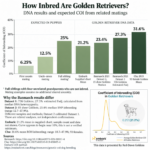
- Golden Retriever inbreeding: This graphic compares Golden Retriever DNA inbreeding estimates ranging from 21.2% to 31.6%, depending on the sample and method. It also shows expected offspring inbreeding from first cousin, uncle and niece, and full sibling matings, assuming no additional shared ancestry.