
Golden Retrievers, Cancer, and Spaying or Neutering: What the Studies Show
Golden Retrievers face a substantial cancer burden. Research also links spaying and neutering with higher occurrence of certain cancers, particularly in female Goldens. Studies across other breeds have found similar associations, although the findings vary by sex, breed, and cancer type.
For these studies, “altered” generally means surgery that removes the ovaries or testicles. “Intact” means those organs remain. The evidence concerns traditional spay and neuter procedures, not every method of preventing reproduction.
How common is cancer in Golden Retrievers?
A 2018 study examined Golden Retrievers that underwent necropsy at a veterinary academic hospital. Among 652 dogs with known ages, 424, or 65%, had died because of cancer. Hemangiosarcoma and lymphoid cancers were the most common cancer diagnoses among the cancer deaths.
These were dogs selected for examination after death at a referral hospital. The finding documents a substantial cancer burden in that population; it does not mean exactly 65% of all Golden Retrievers will die from cancer.
Read Kent et al., 2018: Cancer-related mortality, age, and gonadectomy in Golden Retrievers.
Female Goldens: about 14% in spayed groups versus 4.7% in intact females
The 2020 UC Davis study of 35 breeds included 1,247 Golden Retrievers. Researchers tracked four cancers: lymphoma, mast cell tumor, hemangiosarcoma, and osteosarcoma.
The detailed appendix reported the following numbers for females diagnosed with at least one of those cancers:
| Reproductive status | Females with at least one tracked cancer | Percentage |
|---|---|---|
| Spayed before 6 months | 14 of 121 | 11.6% |
| Spayed at 6–11 months | 16 of 93 | 17.2% |
| Spayed at 12–23 months | 5 of 35 | 14.3% |
| Spayed at 2–8 years | 13 of 93 | 14.0% |
| All four spayed groups combined | 48 of 342 | 14.0% |
| Intact females | 9 of 190 | 4.7% |
Combining the spayed groups gives about three times the recorded cancer occurrence of intact females. The calculation is 48 ÷ 342 × 100 = 14.0%, compared with 9 ÷ 190 × 100 = 4.7%.
This combined percentage is our calculation from the appendix, not an adjusted risk estimate reported by the authors. The analysis included fewer females than the overall population of 374 spayed females because eligibility varied by outcome. These are recorded diagnoses during follow-up, not complete lifetime cancer rates or all possible cancers.
Every spay age group had a higher recorded percentage than the intact group. Delaying spay until adulthood did not bring the observed percentage down to the intact level in this dataset.
Read Hart et al., 2020, including Supplementary Material, Appendix 1, Golden Retriever section.
Male Goldens: early neutering and lymphoma
A 2013 UC Davis study examined 759 Golden Retrievers aged 1–8 years. Males neutered before their first birthday had nearly three times the occurrence of lymphoma compared with intact males.
This finding concerns lymphoma in a particular age-of-neuter group. It does not mean all neutered males have three times the overall cancer risk.
In the expanded 2020 dataset, the recorded occurrence of at least one of the four tracked cancers was 19.4% in males neutered before 6 months, 15.5% at 6–11 months, and 15.3% in intact males. The study’s statistical analysis identified an association with early neutering; the male pattern was less pronounced than the female pattern.
Read Torres de la Riva et al., 2013. Read the expanded Hart et al., 2020 study.
The Golden Retriever Lifetime Study: hemangiosarcoma
A 2023 analysis drew on the 3,044 dogs enrolled in the Golden Retriever Lifetime Study. By September 2022, 233 dogs, or 7.65%, had been diagnosed with hemangiosarcoma.
The researchers’ survival estimates corresponded to an approximately 9% probability of a hemangiosarcoma diagnosis by age 12 in intact females, compared with 39% in spayed females. Estimates for intact and neutered males were approximately 27% and 30%, respectively.
These are statistical estimates, not the percentages of each group already diagnosed. Uncertainty was substantial, especially at older ages. This descriptive analysis does not establish that spaying caused the difference.
Read Hillman et al., 2023: Hemangiosarcoma occurrence in the Golden Retriever Lifetime Study.
Golden retriever lifetime study. Spay data
Beyond Goldens: a 2026 study of 150,063 dogs and cats
A 2026 UC Davis study reviewed hospital records from 150,063 patients: approximately 80% dogs and 20% cats. Overall, 18.1% of the dogs had a cancer diagnosis.
After accounting for age and breed, spayed female dogs had the following odds compared with intact females:
| Cancer category | Higher odds in spayed females |
|---|---|
| Lymphoid cancer, including lymphoma | 43% |
| Mast cell tumor | 92% |
| Melanoma | 63% |
For these three cancer categories, neutering was not significantly associated with increased odds in males. Sarcoma and carcinoma associations varied with age and reproductive status, so a single percentage would misrepresent those findings.
These are relative odds, not the percentage of spayed females that developed cancer. For example, 92% higher odds does not mean 92% of spayed dogs developed mast cell tumors. The study also does not provide one universal lifetime cancer percentage for altered versus intact dogs.
Read Rupasinghe et al., 2026: Canine and feline cancer epidemiology in California.
A study of 90,090 dogs found associations in both sexes
Belanger and colleagues examined 90,090 dogs across 157 breed groups, including crossbreds. Spaying and neutering were associated with higher odds of hemangiosarcoma, lymphoma, mast cell tumor, and osteosarcoma in both sexes, generally with stronger associations in females.
Age at alteration was unavailable for most dogs, limiting conclusions about timing. Because this and several other studies used UC Davis records from overlapping years, their sample sizes should not be added together as if every dog were unique.
Read Belanger et al., 2017: Correlation of neuter status and expression of heritable disorders.
Higher cancer mortality can coexist with longer overall life
A 2013 study analyzed causes of death in 40,139 dogs. Altered dogs were more likely to die from cancer, and that association persisted after accounting for age and breed.
However, in the study’s larger lifespan cohort, altered dogs lived longer on average. They were also less likely to die from infection or trauma. A higher frequency of cancer death does not automatically mean a shorter overall lifespan. Cancer diagnoses, cancer deaths, and longevity measure different outcomes.
Read Hoffman, Creevy, and Promislow, 2013: Reproductive capability, lifespan, and cause of death.
Mixed-breed dogs did not show the same pattern in every study
A 2020 UC Davis study divided mixed-breed dogs into five weight categories. It found no statistically significant increase in the combined occurrence of the four tracked cancers following alteration in any weight category.
The researchers noted limited follow-up into older ages and substantial genetic diversity within mixed-breed groups. This finding does not prove alteration has no cancer effects in mixed breeds, but it shows why Golden Retriever findings cannot simply be assigned to every dog.
Read Hart et al., 2020: Neutering, joint disorders, and cancers in mixed-breed dogs.
What should owners take from this research?
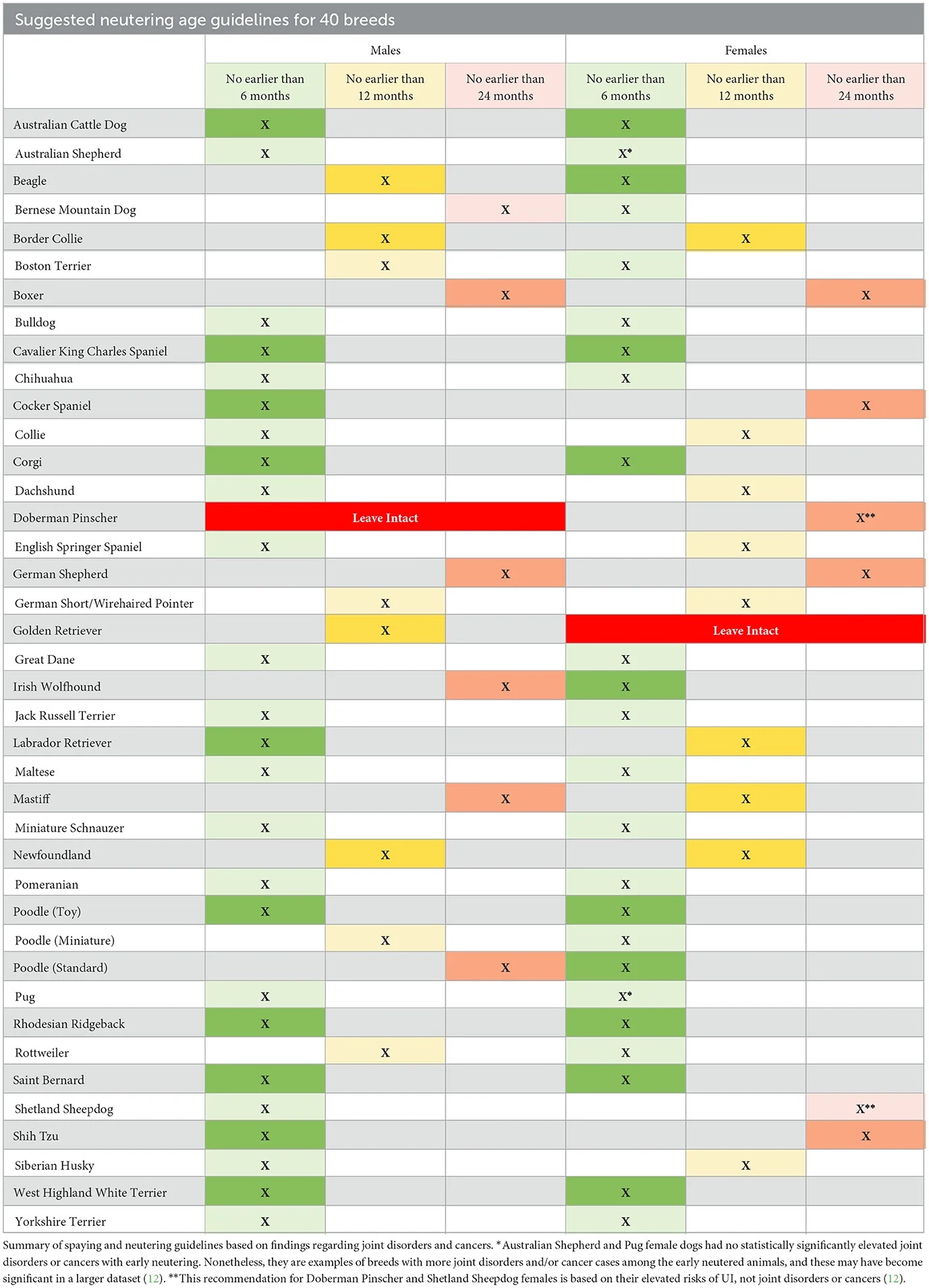
Cancer risk deserves a place in the spay or neuter discussion, especially for female Golden Retrievers. Multiple studies report associations between removal of reproductive organs and certain cancers, but the results depend on sex, breed, cancer type, and the population studied.
These observational studies do not establish that alteration caused the cancers. Traditional spay and neuter also have health benefits: castration prevents testicular cancer, and spaying prevents the usual hormonally driven uterine infection, pyometra. Spaying may also reduce mammary tumor risk, depending on timing and other factors.
Preventing reproduction does not always require removing reproductive hormones. Vasectomy and ovary-sparing hysterectomy are options to discuss with a veterinarian, but the studies above do not establish that those procedures prevent cancer or reproduce the outcomes of intact dogs. Each option has its own benefits and management needs.