Three DNA Testing Platforms, One Golden Retriever Litter: Do Their Genetic Diversity Predictions Agree?
Comparing Embark, UC Davis VGL/BetterBred, and Wisdom Panel Pair Prediction Tools
Each of these three DNA testing platforms offers a Pair Predictor that allows breeders to evaluate the genetic compatibility of two potential parent dogs before breeding them. These tools predict the genetic diversity and inbreeding levels of their future puppies, helping breeders determine whether a proposed mating is a genetically favorable choice.
At Red-Dawn Golden Retrievers, we use multiple genetic testing platforms to evaluate genetic diversity and evaluate potential breeding pairs: Embark, UC Davis Veterinary Genetics Laboratory (VGL) with BetterBred, and Wisdom Panel.
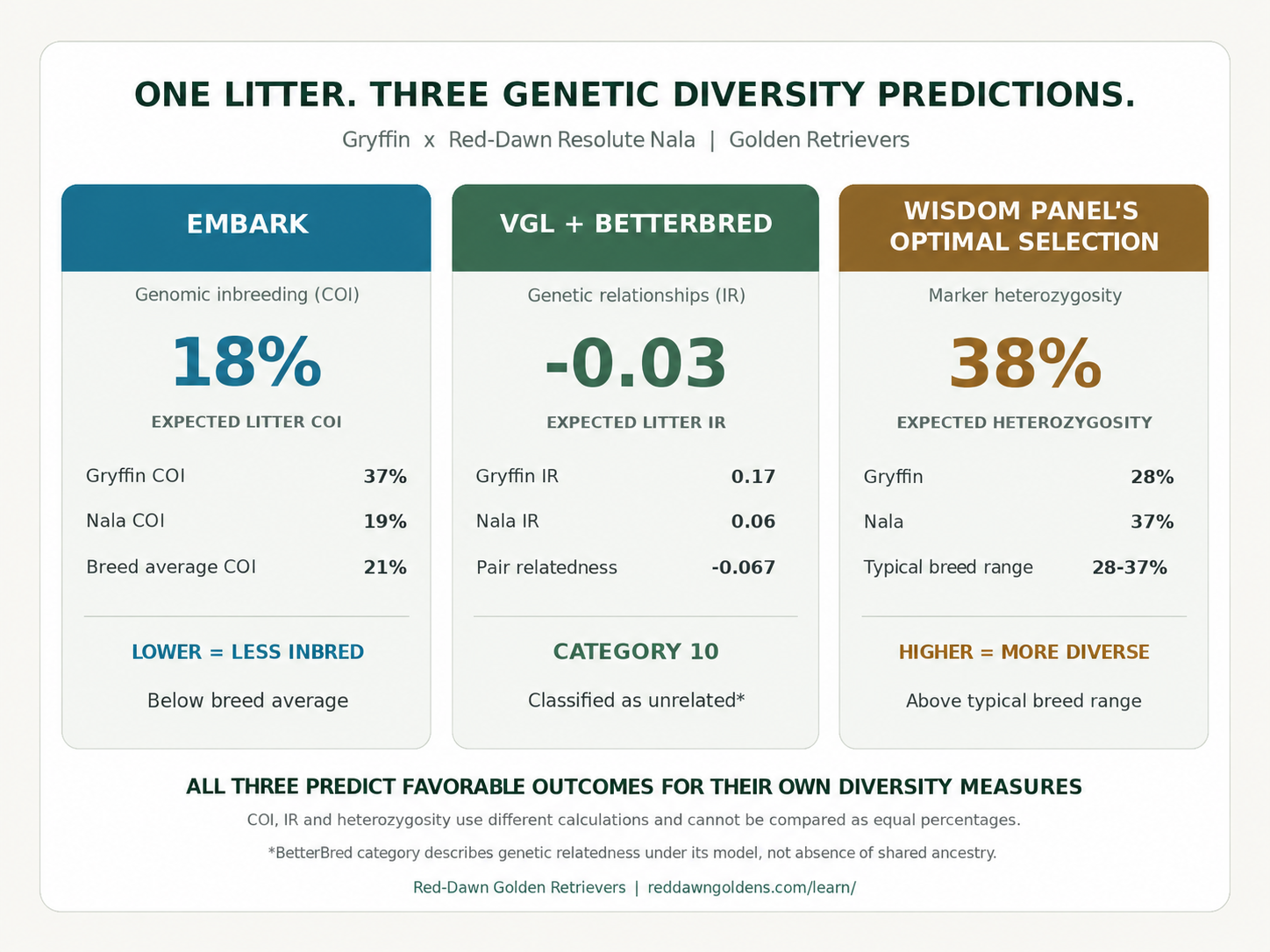
Three Genetic Diversity Predictions
Each company offers tools for predicting the genetic diversity of future puppies. We used each companies’ Pair Predictor tool to compare the exact same Golden Retriever breeding pair.
For this comparison, we used:
- Sire: Gryffin, Birnam Wood’s Too Marvelous For Words
- Dam: Nala, Red-Dawn Resolute Nala
1. Embark: Measuring Genetic Inbreeding
Embark uses SNP (Single Nucleotide Polymorphism) technology to examine thousands of DNA markers across a dog’s chromosomes. It identifies long stretches of identical DNA inherited from common ancestors, called Runs of Homozygosity (ROH). These regions are used to calculate genetic COI. Higher COI means greater inbreeding. Unlike pedigree calculations, SNP testing can detect inbreeding inherited from distant ancestors.
With COI, lower scores means less inbred.
Embark uses DNA markers throughout the genome to identify regions of inherited genetic similarity.
Our Embark DNA results
| Dog or comparison | Genetic COI |
|---|---|
| Gryffin | 37% |
| Nala | 19% |
| Expected puppies prediction | 18% |
| Golden Retriever breed average | 21% |
Gryffin has a considerably higher genetic COI than Nala. However, their predicted puppies have an average genetic COI of 18%. That is lower than either parent and three percentage points below Embark’s reported breed average.
Expected COI by Family Relationship in Dogs on Pedigree Evaluations
Listed from lowest to highest inbreeding.
| Relationship between parents | Expected puppy COI |
|---|---|
| Unrelated dogs with no shared ancestors | 0% |
| Third cousins | 0.78% |
| Second cousins once removed | 1.56% |
| Second cousins | 3.125% |
| First cousins once removed | 3.125% |
| First cousins | 6.25% |
| Great-grandparent × Great-grandchild | 6.25% |
| Great-aunt/uncle × Great-niece/nephew | 6.25% |
| Grandparent × Grandchild | 12.5% |
| Aunt/uncle × Niece/nephew | 12.5% |
| Half-siblings | 12.5% |
| Full siblings | 25% |
| Parent × Offspring | 25% |
How can two inbred dogs produce puppies that are less inbred than their parents?
Because what matters is not just how inbred each parent is, but how much DNA the two parents share with each other.
Gryffin and Nala are both purebred Golden Retrievers, and both have inherited identical stretches of DNA from ancestors within their own family lines. However, their families do not share recent ancestors.
This means Gryffin may have identical DNA in certain chromosome regions, while Nala carries different versions of DNA in those same regions.
When they produce puppies, the puppies inherit one copy of DNA from each parent. Because those copies can be different, the puppies can have less genetic inbreeding than either parent.
Although Gryffin and Nala have no recent shared ancestors, Golden Retrievers still share ancestry from earlier generations. DNA testing can identify inherited similarities resulting from that shared ancestry, including similarities too distant to be obvious in a typical pedigree.
This is why two individually inbred dogs can produce puppies with a lower genetic COI. It is also why evaluating the genetic relationship between breeding partners is more informative than looking at each dog’s individual COI alone.
2. UC Davis VGL and BetterBred: Measuring Genetic Relationships and Population Diversity
Haplotypes: Groups of genetic markers inherited together from one parent. VGL examines DLA haplotypes, which are associated with the canine immune system, to identify genetic variation inherited from each parent’s family lines.
Both help VGL evaluate genetic diversity, but they provide different information: STR markers measure variation at selected locations across the DNA, while DLA haplotypes help track inherited genetic diversity in regions associated with immune function.
BetterBred uses VGL’s information to help breeders understand individual diversity, relationships between dogs, and how commonly their genetic variants occur within the tested breed population.
BetterBred reports several measurements, including:
Internal Relatedness (IR): Evaluates how similar or different the two copies of genetic markers are within an individual dog. Lower IR generally indicates greater marker heterozygosity (less inbreeding).
Outlier Index (OI): Evaluates how unusual a dog’s genetic variants are compared with those found in the tested breed population. A higher score indicates that a dog carries more underrepresented variants for their breed.
Average Genetic Relatedness (AGR): Measures how genetically similar a dog is, on average, to the tested breed population. Lower values indicate that a dog is more genetically distinct from the breed’s population.
BetterBred also estimates genetic relatedness between two potential parents.
Our BetterBred results for Nala and Gryffin
| Measurement | Result |
|---|---|
| Gryffin’s IR | 0.17 |
| Nala’s IR | 0.06 |
| Expected litter IR | −0.03 |
| Pairing genetic relatedness | −0.067 |
| Breed average genetic relatedness | −0.028 |
| Pairing category | Category 10 |
BetterBred assigned this pairing to Category 10, classified as genetically unrelated under its relationship model. (**testing within a breed)
The expected litter IR was −0.03, lower than the IR of either parent. This predicts greater heterozygosity at the markers evaluated by VGL.
BetterBred’s unrelated classification does not mean the dogs have no shared ancestors. It describes their genetic relationship under that testing system for only Golden Retrievers.
What does BetterBred add?
BetterBred helps us investigate whether a breeding dog carries genetic variants that are common or uncommon within the breed. This matters for attempting to maintaining genetic diversity within the closed population of a dog breed.
A breeder can reduce the inbreeding of individual puppies while still losing uncommon genetic variants from the breed if those variants are not preserved in future breeding dogs. VGL helps breeders see this loss or gain of diversity in their potential pairings.
3. Wisdom Panel’s Optimal Selection: Measuring Heterozygosity
Wisdom Panel’s Optimal Selection uses SNP (Single Nucleotide Polymorphism) technology to examine thousands of DNA markers across a dog’s chromosomes. At each marker, it compares the two DNA copies inherited from the parents to determine whether they are identical or different.
The percentage of markers with two different versions is called heterozygosity. Higher heterozygosity means greater genetic diversity at the markers tested, while lower heterozygosity indicates less diversity.
With heterozygosity, higher means more genetic diversity
This is the opposite direction from COI: lower COI is favorable, while higher heterozygosity is favorable.
Our Wisdom Panel’s OS results for Nala and Gryffin
| Dog or comparison | Heterozygosity |
|---|---|
| Gryffin | 28% |
| Nala | 37% |
| Expected puppies | 38% |
| Typical Golden Retriever range | 28–37% |
Wisdom Panel OS predicts that Gryffin and Nala’s puppies will average 38% heterozygosity. This is higher than either parent and slightly above the typical range reported for Golden Retrievers in its comparison population.
Notice that Gryffin has substantially lower heterozygosity than Nala, which is consistent with Embark reporting considerably higher inbreeding for Gryffin.
Once again, the litter prediction improves over both parents. The expected puppies inherit combinations of genetic variants that are more heterozygous than those found in either parent individually.
4. Side by Side: Do the Three Companies Agree?
Here are the Pair Predictor conclusions from the three DNA testing platforms.
| Company | Expected litter result | Interpretation |
|---|---|---|
| Embark | 18% genetic COI | Lower inbreeding than either parent and below the breed average |
| BetterBred / VGL | IR −0.03; Category 10 |
Favorable predicted marker heterozygosity and low parental relatedness; plus, no shared Haplotypes |
| Wisdom Panel OS | 38% heterozygosity | Higher heterozygosity than either parent and above the typical breed range |
All three companies agree on the direction of the predicted outcome.
The mating is favorable according to the particular genetic diversity measurements each platform evaluates. But the actual numerical results cannot be directly compared.
5. Gryffin is highly inbred, should he produce puppies?
Gryffin is a highly inbred Golden Retriever according to Embark, with a genetic COI of 37%. Wisdom Panel OS also reports considerably low heterozygosity for Gryffin. Less Heterozygosity equals more inbreeding.
A breeder looking only at Gryffin’s individual COI might assume that breeding him would produce highly inbred puppies. But that is not what these three breeding predictions indicate.
The results suggest that Gryffin and Nala carry genetic differences that complement each other. Embark predicts lower genomic inbreeding in their offspring. BetterBred predicts a favorable relationship between the parents and greater marker heterozygosity in the offspring. Wisdom Panel predicts more heterozygosity in the offspring than in either parent.
This demonstrates an important principle of genetics:
The genetic diversity of future puppies depends less on how inbred each parent is, but on how genetically similar the two parents are to one another.
6. Does Greater Genetic Diversity Mean Healthier Puppies?
Research has associated greater inbreeding with a variety of unfavorable outcomes in dogs, including reproductive problems, reduced fitness, and shorter lifespans. In Golden Retrievers, large datasets have proven that dogs who are a Golden Retriever mixed with a Poodle have a 75% reduction in Cancer outcomes. Yes you read that correct, Goldendoodles are 75% less likely to have Cancer than a Golden Retriever. Read the Nationwide Insurance data on Cancer
Reducing inbreeding is therefore an important consideration in responsible breeding. However, genetic diversity is not a guarantee of good health. A breeding pair must also be evaluated for inherited disease variants, breed-related health conditions, physical soundness, temperament, and other appropriate health testing.
Two genetically diverse dogs can still produce puppies affected by an inherited disease if both carry a relevant disease-causing variant. Genetic diversity testing is an additional tool, not a replacement for disease testing in the parent dogs or their ancestors.
7. Why We Use More Than One DNA Testing Platform
At Red-Dawn Golden Retrievers, our goal is to find the truth and the science. We have tested our dogs with multiple companies for genetic diversity to know the truth.
Embark helps us evaluate genomic inbreeding (COI). This is crucial to our breeding program because we want to know whether a proposed mating will increase or decrease the genetic inbreeding of future puppies. Embark’s Pair Predictor provides an estimated litter COI, allowing us to make that comparison before breeding.
UC Davis VGL and BetterBred help us evaluate genetic relationships and identify genetic variants that are uncommon within Golden Retrievers. These tools can help us select less-related breeding partners and preserve genetic diversity within the breed. However, they do not provide the same genome-wide COI predictions as Embark, making them less useful for our specific goal of measuring how much we can reduce genomic inbreeding in future puppies.
Wisdom Panel Optimal Selection measures heterozygosity using SNP technology, similar to the technology used by Embark. Although the companies calculate different genetic diversity measurements, both provide valuable information about genetic variation. We highly recommend Wisdom Panel as a tool for evaluating genetic diversity in breeding dogs.
For Gryffin and Nala, the three methods reached compatible conclusions despite examining different characteristics of their DNA.
At Red-Dawn, we believe that understanding genetic diversity is an important part of creating Golden Retrievers.
Learn More
For additional information on canine genetic diversity, DNA testing, and the science of inbreeding, visit:
https://reddawngoldens.com/learn/
Additional sources
Embark genetic COI: https://embarkvet.com/pages/genetic-coefficient-inbreeding
Embark COI explanation: https://help.embarkvet.com/hc/en-us/articles/115000246234-What-is-COI-Coefficient-of-Inbreeding
VGL’s Canine Genetic Diversity test: https://vgl.ucdavis.edu/test/canine-genetic-diversity
BetterBred methodology: https://www.betterbred.com/methodology/
Wisdom Panel’s Optimal Selection Pair Predictor Tool: https://optimal-selection.com/blogs/news/a-litter-predict-user-guide
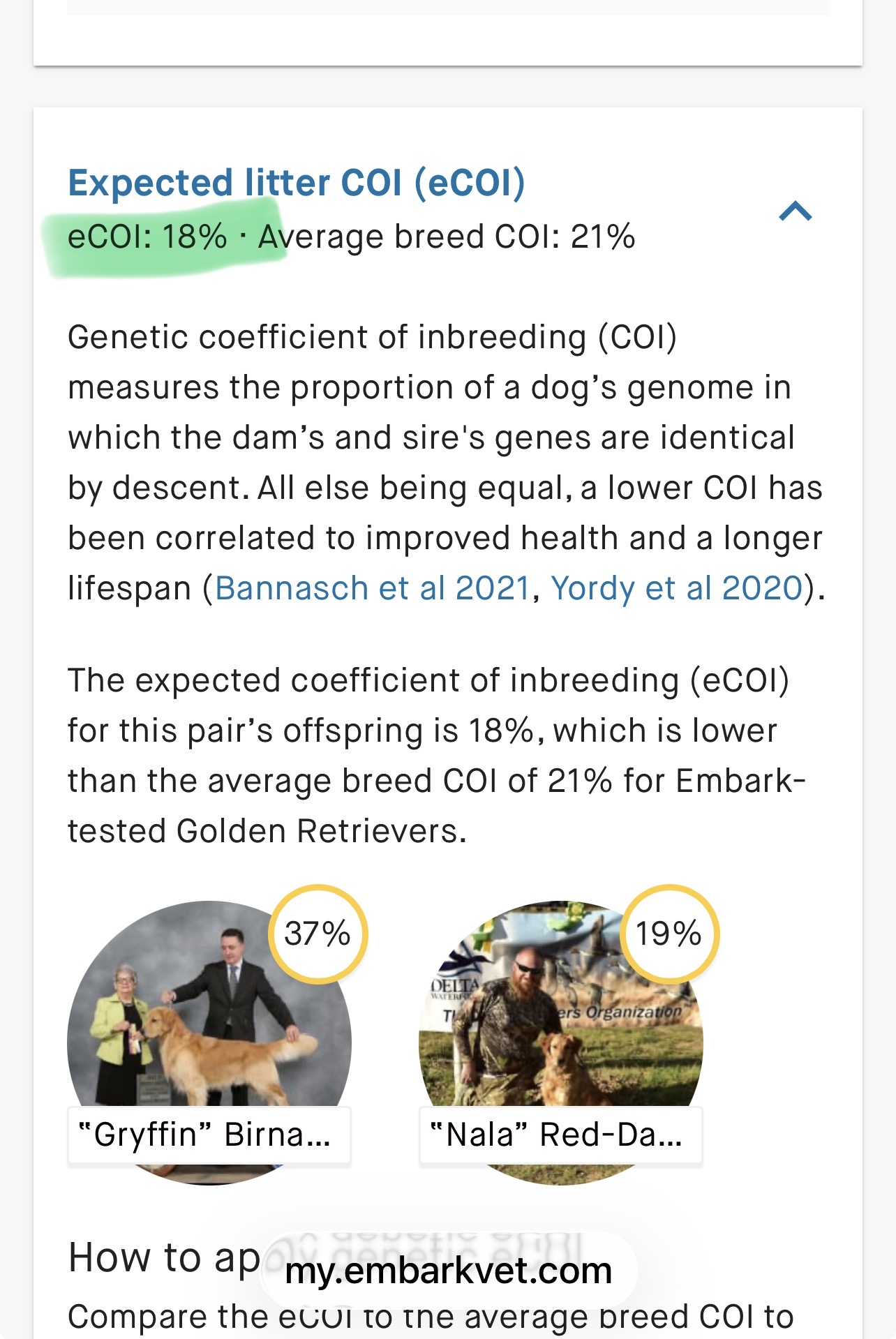
Embark’s Pair Predictor
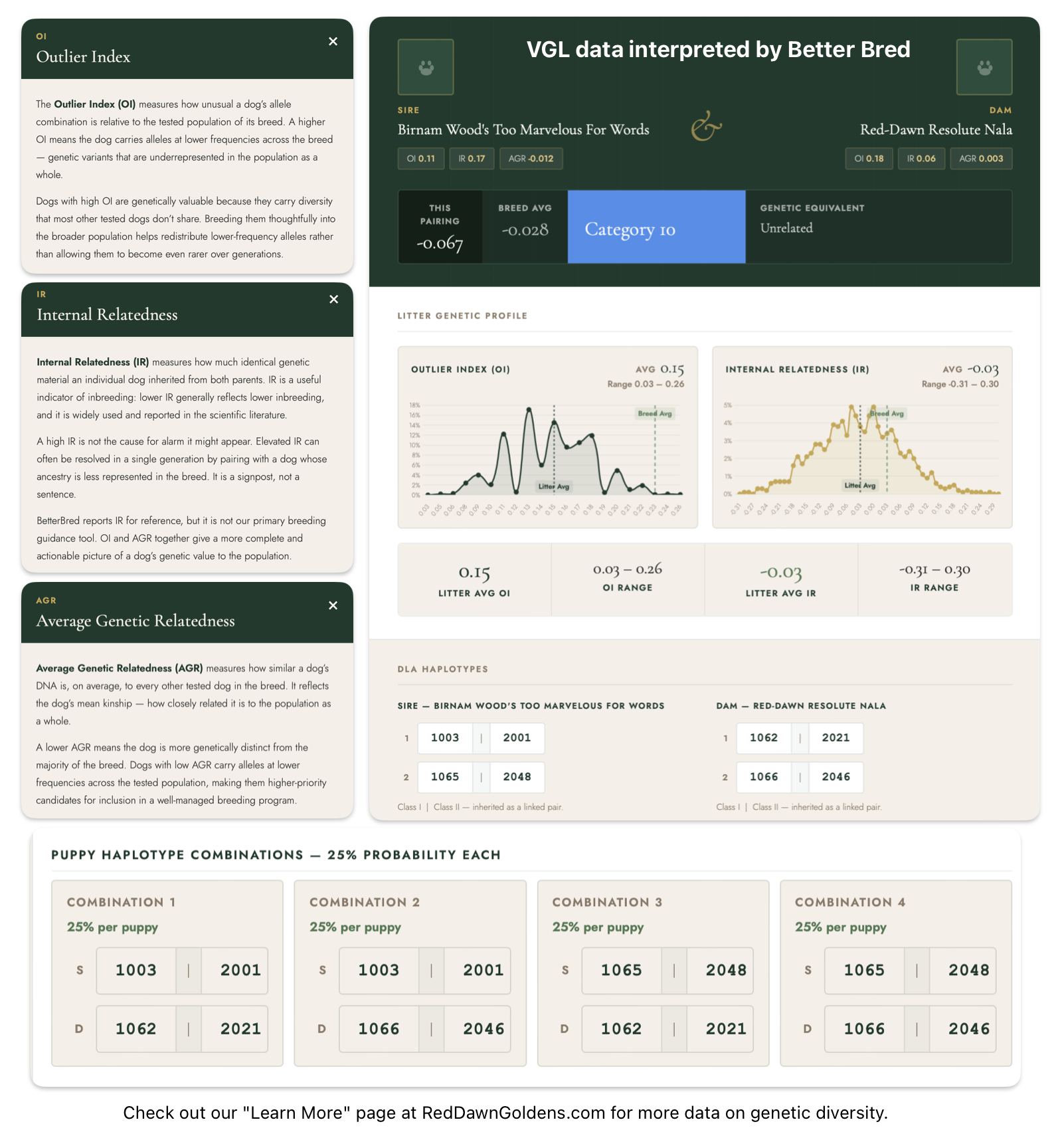
VGL Genetic Diversity of potential future puppies, interpreted by Better Bred
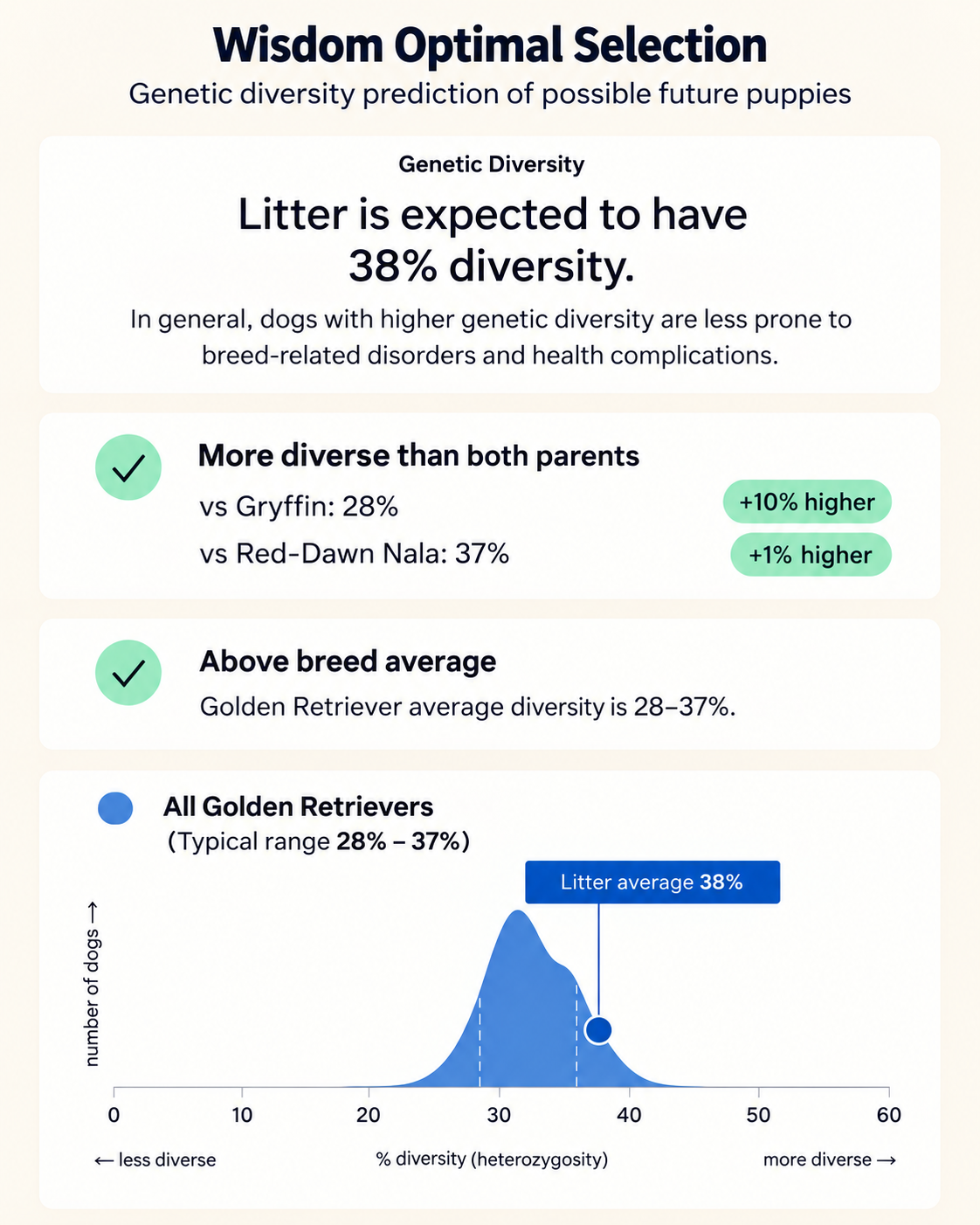
Wisdom Optimal Selection Pair Predictor